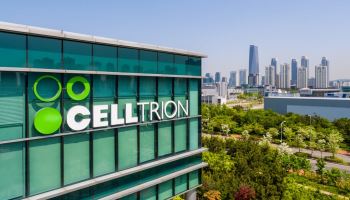
 | | Celltrion CI (Source: Celltrion) |
|
[Kim Saemi, Edaily Reporter] Celltrion announced on November 12 that it has submitted an application to Australia‘s Therapeutic Goods Administration (TGA) for marketing authorization of Besequma (development code: CT-P55), its proposed biosimilar to Novartis’ autoimmune disease treatment Cosentyx (secukinumab).
The application covers all indications approved for the reference product in Australia, including plaque psoriasis, psoriatic arthritis, ankylosing spondylitis and juvenile idiopathic arthritis.
Celltrion previously conducted a clinical study involving 172 healthy adults, demonstrating pharmacokinetic (PK) equivalence between Besequma and the reference product. The study also showed comparable safety and immunogenicity profiles.
The company began its global regulatory submissions in Canada in May, followed by South Korea in June and the United States and Europe in July. With the latest filing in Australia, Celltrion has expanded its regulatory footprint across North America, Europe, Asia and Oceania.
Besequma is a proposed biosimilar to Cosentyx, an interleukin-17A (IL-17A) inhibitor developed by Novartis for the treatment of autoimmune diseases. Cosentyx generated approximately $6.67 billion (9.3 trillion won) in global sales in 2025, making it a major blockbuster drug.
Celltrion aims to strengthen its autoimmune disease portfolio through the commercialization of Besequma. The company currently markets several biosimilars in this therapeutic area, including Remsima, Remsima SC (marketed as Zymfentra in the US), Yuflyma, Steqeyma and Avtozma. The launch of Besequma would expand its presence into the IL-17A inhibitor market.
Australia is an established market for Celltrion, where the company has built a commercial presence through its existing autoimmune disease treatments. Celltrion plans to leverage its local sales experience and distribution network to support Besequma‘s market entry.
“Besequma is accelerating its global expansion with regulatory submissions in Australia following the US, Europe and South Korea,” a Celltrion official said. “We will continue expanding our regulatory filings to strengthen the growth momentum of our biosimilar business.”
Meanwhile, Celltrion plans to expand its commercialized biosimilar portfolio from 11 products to 18 by 2030.
In the autoimmune disease segment, the company is developing CT-P53, a proposed biosimilar to Ocrevus, and CT-P52, a proposed biosimilar to Taltz. Its oncology pipeline also includes CT-P51, a proposed biosimilar to Keytruda, and CT-P44, a proposed biosimilar to Darzalex.