Unauthorized reproduction or distribution is illegal and subject to criminal penalties.
Pharm Edaily enforces a zero-tolerance policy and will take strict action.
[Lim Jeong-yeo, Edaily reporter] On the 11th in the domestic pharmaceutical and biotech stock market AprilBio which had plunged the previous day due to share sales by company executives hit the daily upper limit after its U.S. partner announced positive Phase 2a clinical data. Rokit Healthcare and Hugel, which posted strong preliminary earnings disclosures, also surged by more than 10%.
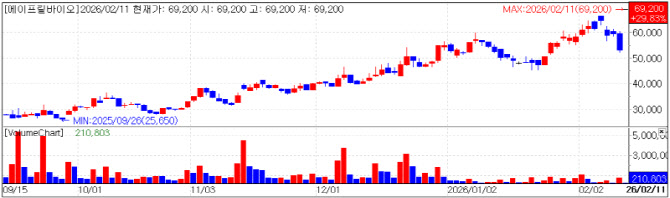 | | AprilBio stock chart (Source: KG Zeroin MP Doctor) |
|
AprilBio soars on Evommune‘s AD Phase 2a results According to KG Zeroin MP Doctor (formerly Market Point), AprilBio on Wednesday closed at 69,200 won, up 29.83% (15,900 won) from the previous day.
The surge followed the announcement by Evommune, AprilBio’s U.S. partner, of positive Phase 2a results for APB-R3 (EVO301), an intravenous formulation for atopic dermatitis. Based on these results, Evommune stated that it plans to proceed with a Phase 2b trial of a subcutaneous formulation of EVO301 and is also considering ulcerative colitis as an additional indication.
AprilBio is eligible to receive milestone payments upon first patient dosing in the Phase 2b trial and upon first patient dosing for any additional indications. Approximately 667.7 billion won in milestone payments remain outstanding for AprilBio under its agreement with Evommune.
On the 9th, AprilBio had closed at 63,300 won, down 10.42% (6,200 won), due to the impact of stock sales by executives. Investor anxiety spread as executives sold shares ahead of major clinical data announcements.
Jin Hong-guk, Executive Director in charge of External Strategy, exercised stock options to acquire 55,500 shares at 10,875 won and, just one month later on the 9th, sold 45,500 shares on the open market at prices between 56,000 and 64,000 won, realizing a profit of approximately 2.2 billion won. He retained 10,000 shares.
Ji Soo-seon, Executive Director in charge of Development Support, acquired 2,500 shares at 7,625 won and sold all of them on the open market at 56,900 won, securing a profit of about 1.2 billion won. Seo Sang jun Vice President and Management Advisor, exercised 33,000 shares at 3,020 won and sold them on the open market at 56,699 won, realizing a profit of around 1.7 billion won.
As these three executives simultaneously sold their stakes, the market grew skeptical about upcoming data announcements, which contributed to stock‘s decline. Ironically, later that same evening, Evommune released the positive Phase 2a results, causing AprilBio’s share price to swing sharply between losses and gains.
In fact, this is not the first time AprilBio executives have realized gains through stock option exercises. AprilBio, which listed on the KOSDAQ on July 28, 2022, imposed a three year lock up period on executives starting from the listing date. After the lock up expired executives frequently took profits even when the stock was in the 20,000~30,000 won range.
Vice President Seo also realized a 1 billion won profit last December, while Executive Director Ji booked profits of 200 million won each in August and September. The same applies to other executives, including Kim Jong min (Executive Director, Management Control) and Kim Jin-taek (Executive Director, Corporate Planning).
As this case demonstrates that executive share sales were not a precursor to negative corporate events, some observers suggest that perceptions around stock-option-based compensation systems may improve for AprilBio and the broader biotech sector. Since its listing, AprilBio has granted stock options to employees on five occasions.
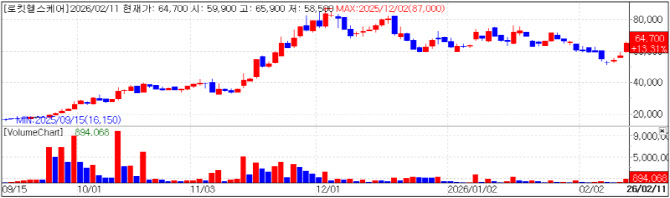 | | Rokit Healthcare chart(Source: KG Zeroin MP Doctor) |
|
Rokit Healthcare turns profitable On the same day, regenerative therapy company Rokit Healthcare closed at 64,700 won, up 13.31% (7,600 won) from the previous day. The rally followed the company‘s disclosure that it achieved double digit year on year revenue growth and a return to operating profitability.
Rokit Healthcare is one of the few companies listed on the KOSDAQ under the technology special listing system to achieve profitability shortly after going public. According to earnings disclosed on the 11th the company recorded consolidated revenue of 26.2 billion won last year, representing a twofold increase year on year. Annual operating results swung to an operating profit of 600 million won in 2025, compared with an operating loss of 5.5 billion won in 2024.
Net income for the year posted a loss of 2.2 billion won, an improvement from the 7.6 billion won loss recorded in the previous year. Regarding the net loss, the company explained that this figure reflects accounting losses from the valuation of convertible bonds and other instruments with no actual cash outflow adding that once the conversion of convertible bonds is completed, its capital base and financial structure will become even more solid.
A Rokit Healthcare official said, “In terms of the breakdown of consolidated revenue, Rokit Healthcare, which operates the long-term regenerative 3D bioprinter business, accounts for 50~60%; Rokit America, which sells reverse-aging health supplements, accounts for 30~40% and genomic analysis company Rokit Genomics accounts for 10%.”
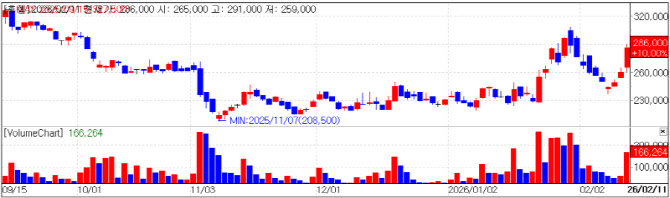 | | Hugel stock chart (Source: KG Zeroin MP Doctor) |
|
Hugel jumps over 10% on strong earnings On the day Hugel closed at 286,000 won, up 10% (26,000 won). The rise followed the company’s disclosure that its annual revenue surpassed the 400 billion won mark for the first time last year.
Hugel reported consolidated revenue of 425.1 billion won in 2025, up 14% from 373.0 billion won the previous year. Operating profit increased 21.3% year on year to 201.6 billion won, from 166.2 billion won, while net income remained flat at 143.9 billion won.
The company attributed the strong performance to solid global sales of its botulinum toxin “Botulax” (Letybo), hyaluronic acid fillers “The Chaeum” (Revolax, etc.), and Byryzn, as well as rapid growth in its cosmetics brands “Wellage” and “Byryzn BR.”
Botulinum toxin sales reached 238.8 billion won, up 15% year on year; filler sales totaled 129.7 billion won, up 1.7%; and cosmetics and other product sales rose 45.9% year-on-year to 61.6 billion won.
Growth in toxins and fillers was particularly strong in North and South America, including the United States and Brazil, where combined sales doubled year-on-year to 67.9 billion won.
Hugel stated that it plans to accelerate global expansion while simultaneously driving scale and profitability, with a focus on the United States, the world‘s largest toxin market.
As part of its U.S. market penetration strategy, the company will begin fully implementing a hybrid sales model this year, combining partner led distribution with direct sales.
Carrie Strom, Global CEO of Hugel said “Based on Hugel’s strong global competitiveness, we achieved our first-ever annual revenue in the 400 billion won range.”
adding “This year, we plan to further solidify our mid- to long term global growth foundation, centered on the four major global markets the U.S., China, Europe, and Brazil.”
![Investor Sentiment Rebounds, HLB·VUNO·BNC Korea Drive Market Turning Point[K-Bio Pulse]](https://image.edaily.co.kr/images/vision/files/NP/S/2026/09/PS26092900352b.jpg)

![바람 잘 날 없는 K바이오…오름 ‘임상 중단 쇼크’에 下[바이오 맥짚기]](https://image.edaily.co.kr/images/vision/files/NP/S/2026/09/PS26092100095b.jpg)
![[바이오스터디] AI로 꿀잠 자는 방법 알려드립니다...침실에서 병원까지 데이터로 잠을 분석하는 에이슬립 (이동헌 대표)](https://i.ytimg.com/vi/MM7dtvyr9Go/mqdefault.jpg)