Unauthorized reproduction or distribution is illegal and subject to criminal penalties.
Pharm Edaily enforces a zero-tolerance policy and will take strict action.
[Yu Jin-hee, Edaily Reporter] Amid broader market choppiness on Thursday, South Korea‘s biopharmaceutical sector lacked a clear directional trend, leaving traditional, profitable pharma and biotech firms to anchor investor sentiment.
While stocks backed by solid fundamentals maintained steady gains despite heightened volatility, companies exposed to supply-demand imbalances and financial risks experienced extreme price swings, confronting harsh market realities.
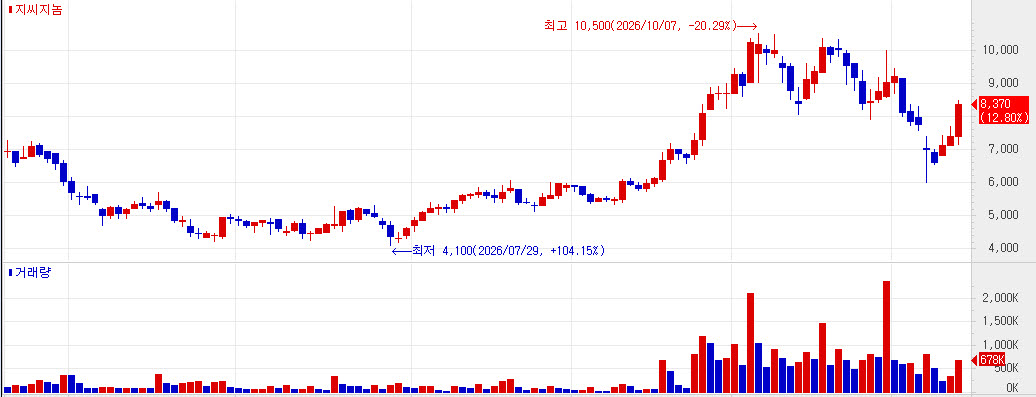 | | Recent stock price trend of GC Genome. (Source: KG Zeroin MP DOCTOR) |
|
GC Genome Gains on U.S. Pancreatic Cancer Test Progress and Solid Earnings According to KG Zeroin MP Doctor, representative biotech stocks posting double-digit fluctuations among the day’s top gainers and losers included Moalife Plus, GC Genome, and Baropharm.
Their share prices diverged sharply: Moalife Plus surged 30.00% to close at 117 won, GC Genome rose 13.20% to 8,400 won, and Baropharm tumbled 18.42% to 9,610 won.
Market analysts noted that newly listed Baropharm faced immediate overhang (potential sell-off volume) pressures and Moalife Plus suffered supply-demand distortions after its parent company triggered an event of default (EOD). In contrast, GC Genome acted as a stabilizing pillar for sector sentiment, backed by steady core profits and tangible progress toward U.S. commercialization.
Buying interest in GC Genome was driven by consistent domestic profitability and expectations for the U.S. launch of its early pancreatic cancer screening test. Brokerage houses have highlighted the company‘s steep earnings trajectory. Korea Investment & Securities projected in a recent report that GC Genome’s third-quarter consolidated revenue rose 17.8% year-on-year to 10.4 billion won, with operating profit jumping 31.3% to 1 billion won.
With an estimated operating margin of 9.7%, the company is expected to extend its consecutive quarterly operating profit streak that began in the second quarter of last year. Samsung Securities also positively assessed GC Genome‘s five-quarter profit streak, citing first-half revenue of 15.7 billion won (up 8% YoY) and operating profit of 600 million won (up 119% YoY).
Core domestic diagnostic services remain the backbone of this performance. Volume for G-NIPT, a non-invasive prenatal test analyzing fetal DNA in maternal blood for chromosomal abnormalities, grew steadily from 14,000 tests in 2023 to 18,000 in 2024 and 25,200 last year, approaching 30,000 tests this year.
Meanwhile, ai-CANCERCH, a non-reimbursed multi-cancer early detection test utilizing cell-free DNA, has gained traction across all domestic tertiary general hospitals and roughly 40% of general hospitals. Test volume surged from 900 in 2024 to 5,100 last year, already surpassing 4,100 in the first half of this year, with corporate clients slated to expand to around 160 by year-end.
Exports to Japan, which began in the first quarter, alongside anticipated local Japanese certification in Q1 next year, serve as additional growth drivers. However, the key catalyst for a medium-to-long-term valuation re-rating is Pancsight, an early pancreatic cancer screening test targeting the U.S. market. Developed via affiliate GC LabTech—in which GC Genome holds a 24.1% stake—Pancsight demonstrated encouraging U.S. clinical results across 2,800 samples, achieving 93.7% sensitivity and 95.4% specificity. Notably, sensitivity for early-stage (Stages I and II) pancreatic cancer, which critically determines patient prognosis, reached 87.5%.
Based on this clinical data, GC Genome plans to submit a pre-submission package to the U.S. Food and Drug Administration (FDA) this month, apply for Breakthrough Device Designation (BDD) by Q1 next year, complete clearance procedures within the year, and launch commercially the following year. U.S. distribution will be handled by Guardant Health, a global liquid biopsy leader with an established commercial network built around its colorectal cancer test, Guardant Shield.
“Leveraging the strong hospital network of its traditional pharmaceutical group and stable cash generation, GC Genome is entering high-value overseas diagnostic markets,” a brokerage official said. “If U.S. distribution partnerships settle smoothly and prospective clinical data accumulates for insurance reimbursement, achieving its 2028 target for U.S. Laboratory Developed Test (LDT) commercialization and insurance code listing is well within reach.”
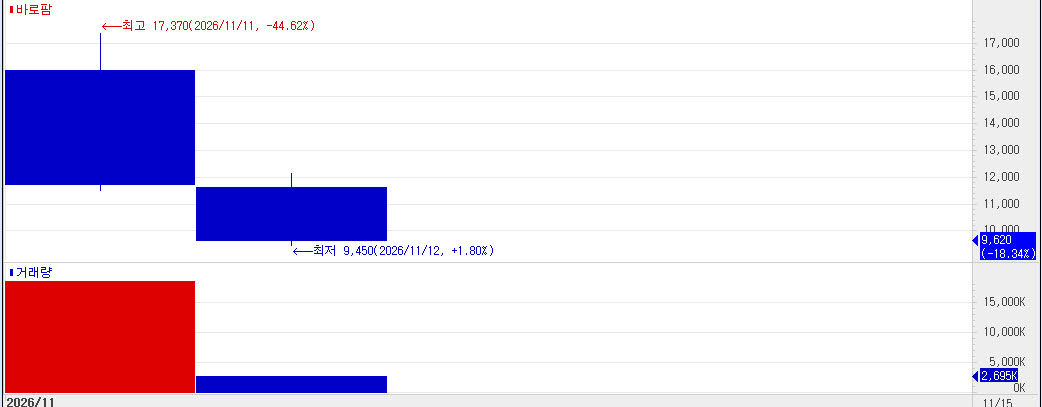 | | Recent stock price trend of Baropharm. (Source: KG Zeroin MP DOCTOR) |
|
Baropharm Tumbles as Venture Capitalists Exit Immediately Post-IPO While GC Genome cruised on core competitiveness, pharmacy-integrated platform operator Baropharm suffered a bitter post-IPO debut due to massive profit-taking sell-offs. Following a plunge of over 28% on its Nov. 11 listing debut, the stock extended its steep decline for a second consecutive day, falling well below its IPO price band of 16,400 to 20,200 won.
The immediate trigger for the sell-off was exit volume from early financial investors (FIs), specifically venture capital (VC) funds. The Korea Exchange (KRX) designated Baropharm as an “investment caution stock for high single-account trading volume” for Nov. 12 after a single account net sold 433,836 shares—3.63% of total listed shares—on debut day.
Under KRX classification systems, unincorporated venture funds are categorized as “retail” accounts, and market participants point to the KB Global Platform Fund as the seller. Essentially, the entire tradable, non-lockup portion (433,836 shares) of the fund’s 867,673-share stake was dumped onto the market on listing day.
Despite severe supply-demand headwinds weighing on the stock, analysts largely view Baropharm‘s business fundamentals as sound. Founded in 2019 by pharmacist Kim Seul-gi, Baropharm is South Korea’s largest pharmacy order-integration platform, counting 24,787 pharmacies—over 90% of the nation‘s total—as members.
Capitalizing on an overwhelming cumulative Total Gross Merchandise Value (TGMV) of 7.2 trillion won, the company expanded into direct-purchase distribution (BMS) and private brand (PB) businesses, achieving an earnings turnaround. Consolidated Q3 revenue jumped 77.9% year-on-year to 49.6 billion won, swinging to an operating profit of 2.3 billion won.
Building on first-half revenue of 69 billion won and operating profit of 2.2 billion won, Baropharm is accelerating its healthcare Artificial Intelligence Transformation (AX) ecosystem using IPO proceeds. Early next year, it will officially launch “BaroAI,” a pharmacist-dedicated AI agent trained on 7 trillion won worth of real transaction data, alongside a drug supply-demand forecasting and automated ordering engine, while expanding into the physician platform “BaroMD” and a telemedicine prescription linkage solution (BPCS).
The company also plans to invest 14 billion won to expand manufacturing facilities at subsidiary CHD Pharm to boost in-house production and lower its cost-of-goods-sold ratio below 50%, shifting away from low-margin direct distribution toward a high-margin structure.
However, resolving lingering overhang risks remains a prerequisite for a near-term share recovery, as roughly 780,000 tradable shares held by major shareholders—including Company K New Deal Fund (213,776 shares) and KB Digital Platform Fund (257,834 shares)—remain poised for potential release.
“Although Baropharm possesses clear strengths in its dominant market position and profit turnaround, it is undergoing an excessive correction due to post-IPO supply-demand imbalances,” a financial investment industry official said. “A true valuation re-rating will occur only after the three-month put-back option window for retail subscribers passes and existing VC overhang is digested.”
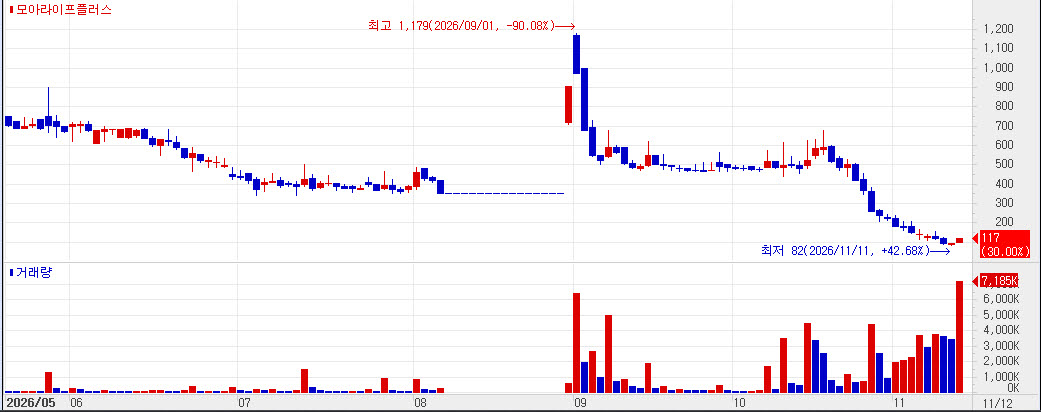 | | Recent stock price trend of Moalife Plus. (Source: KG Zeroin MP DOCTOR) |
|
The Paradox of Moalife Plus’s Limit-Up Surge Amid Parent Company‘s Default Crisis Moalife Plus, which hit the daily upper price limit to top the market’s gainers list, faces the most precarious crisis beneath its superficial rally. Caught between positive biotech licensing news and severe liquidity distress alongside creditor collateral enforcement at parent company Moadata, market watchers view the surge with caution as a classic “dead cat bounce” or speculative volatility driven by distorted supply and demand.
On Nov. 10, Moalife Plus plunged following a massive net sell-off of 679,649 shares—3.12% of its 21,779,615 listed shares—from a single corporate account, prompting the KRX to designate it an investment caution stock on Nov. 11.
Behind the dumping lies cascading financial deterioration at parent firm Moadata. The AI-based anomaly detection firm posted an operating loss of 5.93 billion won last year due to core business slumps, followed by a 3.7 billion won deficit in the first half of this year, severely eroding its cash generation.
As refinancing via mezzanine debt—such as convertible bonds (CBs) and bonds with warrants (BWs)—hit a wall, the crisis spiraled out of control. In August, Moadata received an EOD notice from Sangsangin Savings Bank over 4.84 billion won in overdue loans, and its debt-to-equity ratio surged to 570% by the end of H1 following derivative valuation losses.
Crucially, Moadata had pledged 6.1 million shares of subsidiary Moalife Plus as loan collateral, while Moadata BWs and common shares held by Moalife Plus were also tied up as collateral, pushing the entire group‘s governance and liquidity toward collapse.
On Nov. 4, creditor Sangsangin Savings Bank disclosed that it had acquired collateral disposal rights over roughly 1.73 million Moadata shares and mezzanine securities due to the EOD. When Moadata resumed trading on Nov. 11, a wave of forced margin-call selling sent the stock plunging to its daily lower limit. Exposed to contagion risks and creditor collateral liquidation pressures, Moalife Plus also tumbled into penny-stock territory in the 100-won range.
Nevertheless, Moalife Plus’s underlying drug pipeline continues to draw market interest. Muscle-wasting treatment candidates EL-22 (formerly BLS-M22) and EL-32 (formerly BLS-M32), licensed out to U.S. biotech firm NorthStrive Biosciences, are gaining attention as potential solutions to muscle loss side effects associated with Glucagon-Like Peptide-1 (GLP-1) obesity drugs.
NorthStrive initiated comparability studies between U.S.-manufactured and existing drug substances in August in preparation for a Phase 2 Investigational New Drug (IND) filing. In September, it also filed a U.S. patent application for preventing microgravity-induced muscle loss during long-duration spaceflight, broadening its therapeutic scope. Moalife Plus stands to receive a $3 million (approx. 4 billion won) milestone payment upon the initiation of U.S. Phase 2 clinical trials.
Industry experts advise separating Moalife Plus‘s technological potential from its group governance risks.
“While it is encouraging that Moalife Plus’s obesity and space-related muscle loss pipelines are progressing through its global partner, current share price swings stem from a distorted clash between forced collateral liquidations triggered by its parent‘s EOD and bargain-hunting, rather than drug value,” a biotech industry official said. “Investors must exercise extreme caution regarding violent price volatility until Moadata’s treasury bond resale delays and creditor collateral disposal issues are fully resolved.”