Unauthorized reproduction or distribution is illegal and subject to criminal penalties.
Pharm Edaily enforces a zero-tolerance policy and will take strict action.
[Kim Saemi, Edaily Reporter] Infectious disease-related stocks rallied across South Korea‘s biotech and healthcare sector on May 19 amid growing concerns over the spread of Ebola and hantavirus. The spillover effect from AriBio’s major Alzheimer‘s drug licensing deal also continued, while Huons and Huons Global moved in opposite directions on news of Huons Lab’s planned merger.
Ebola, Hantavirus Fears Lift Infectious Disease Theme Stocks 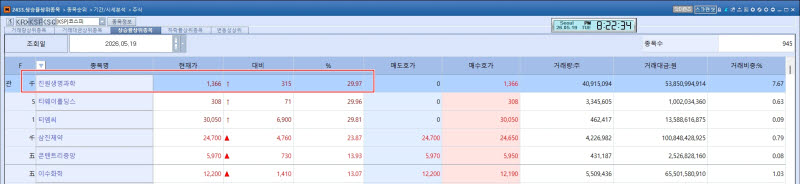 | | Top Kospi Gainers on May 19 (Source: KG Zeroin’s MP DOCTOR) |
|
According to KG Zeroin‘s MP DOCTOR, formerly MarketPoint, GeneOne Life Science surged by the daily limit of 315 won, or 29.97%, to close at 1,366 won. Bioneer also jumped more than 10% during intraday trading before paring gains to finish up 770 won, or 8.42%, at 9,910 won.
The World Health Organization declared the Ebola virus disease outbreak a Public Health Emergency of International Concern, or PHEIC, on May 17. The virus identified in the latest outbreak is the Bundibugyo strain, for which there are currently no approved vaccines or specific treatments. However, the WHO said the outbreak does not meet the criteria for a global pandemic.
The Ebola outbreak concerns appear to have driven gains in GeneOne Life Science and Bioneer. GeneOne Life Science has a history of jointly developing an Ebola DNA vaccine with Inovio Pharmaceuticals. Bioneer previously discussed supplying Ebola molecular diagnostic kits to Nigeria in 2014.
Concerns over the spread of hantavirus also fueled gains in infectious disease theme stocks, lifting Covid-19 vaccine, diagnostic kit and quarantine-related names. GC MS rose 18.97%, CHA Vaccine Institute gained 11.33% and EyeGene advanced 10.31%.
Recently, a hantavirus cluster was reported on a cruise ship that departed South America, with fatalities prompting health authorities in multiple countries to quarantine and monitor contacts. Hantavirus cardiopulmonary syndrome, or HCPS, is a potentially fatal disease with a mortality rate approaching 50%. The WHO immediately raised the risk level to “moderate.”
In South Korea, the Korea Disease Control and Prevention Agency is pursuing a hantavirus vaccine development project. Investor interest in domestic messenger RNA, or mRNA, vaccine technology grew after EyeGene was reported on May 18 to have been selected as a partner for the government project.
“As concerns over infectious disease outbreaks grow, so-called ’old memory stocks‘ that surged during the Covid-19 pandemic are once again drawing attention in rotation,” a biotech industry official said. “However, as the current situation has not spread as widely as Covid-19, the rally is more likely to remain a short-lived theme-driven move rather than a sustained trend.”
AR1001 Deal Glow Lifts Samjin Pharm, CHA Vaccine Institute 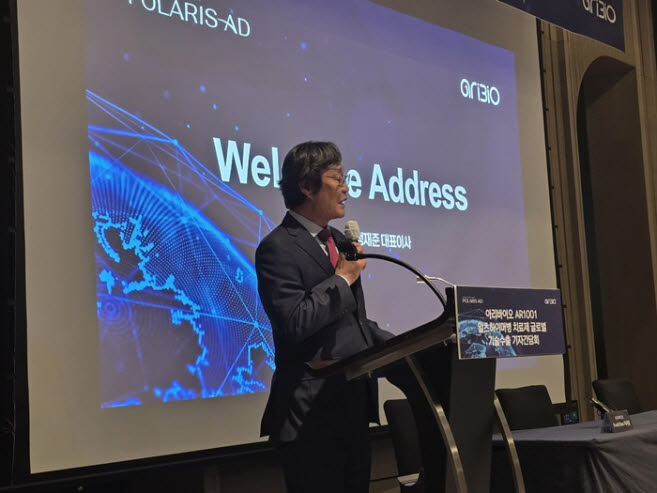 | | AriBio Co-CEO Jeong Jae-jun gives a presentation at a press conference held at the Fairmont Ambassador Seoul hotel in Yeouido, Seoul, on May 18. (Source: Edaily reporter Song Young-doo) |
|
Samjin Pharm and CHA Vaccine Institute also rallied, apparently supported by the halo effect from AriBio’s major deal for its Alzheimer‘s disease candidate AR1001.
Samjin Pharm closed at 24,700 won, up 4,760 won, or 23.87%, from the previous session. CHA Vaccine Institute ended at 3,735 won, up 380 won, or 11.33%.
The two companies share a link to AriBio. AriBio announced on May 14 that it signed a global exclusive licensing deal with China’s Fosun Pharma for its oral Alzheimer‘s disease treatment AR1001, worth up to $4.7 billion, or about 7 trillion won. Following the announcement, Sorux, a Kosdaq-listed company pursuing a merger with AriBio, hit the daily upper limit for two consecutive sessions on May 14 and 15 and continued its uptrend through May 19. Sorux is a lighting company whose management control was acquired by AriBio CEO Jeong Jae-jun in 2023. After the acquisition, Sorux purchased shares in AriBio, creating a governance structure linking Jeong, Sorux and AriBio.
Samjin Pharm is AriBio’s domestic partner for the oral Alzheimer‘s disease treatment AR1001. The two companies signed an agreement in 2023 to jointly conduct the domestic phase 3 trial of AR1001 and for Samjin Pharm to acquire exclusive domestic manufacturing and sales rights. The deal is worth up to 100 billion won, including an upfront payment of 10 billion won. Under the arrangement, Samjin Pharm is set to receive manufacturing technology and know-how for AR1001 while securing exclusive sales rights in Korea.
As AR1001’s global commercialization prospects improve, the value of Samjin Pharm‘s domestic manufacturing and sales rights could gain more attention. AriBio’s licensing deal with Fosun Pharma appears to have been reflected in Samjin Pharm‘s share price. “The strength in our share price seems to have been largely influenced by AriBio,” a Samjin Pharm official said.
CHA Vaccine Institute became linked to AriBio through the governance restructuring involving Sorux and AriBio. In March, CHA Biotech agreed to sell about 8.94 million shares of CHA Vaccine Institute to Sorux and AriBio-related special purpose investment companies. CHA Vaccine Institute later changed its name to AriBio Lab.
As Sorux is pursuing a merger with AriBio, the market has come to perceive CHA Vaccine Institute as an AriBio-related company. Expectations surrounding AriBio’s large AR1001 licensing deal therefore appear to have also affected CHA Vaccine Institute‘s share price.
Huons Rises on Huons Lab Merger, While Huons Global Retail Investors Feel Left Out  | | Huons Lab CI (Source: Huons Group) |
|
Huons and Huons Global diverged after news of the planned Huons Lab merger.
Huons Lab is a subsidiary of Huons Global but is set to be absorbed by Huons. Huons and Huons Global disclosed the merger plan after market close on May 18.
Following the announcement, Huons jumped 5,800 won, or 17.9%, to close at 38,200 won. Huons Global, however, fell 2,200 won, or 5.81%, to finish at 35,650 won.
The starkly different share price movements appear to reflect market views that the ownership of Huons Lab’s biotech premium is effectively shifting. Huons Lab is a biotech R&D company that owns Hydiffuze, a human-derived hyaluronidase-based subcutaneous, or SC, drug delivery platform. Through the merger, Huons is expected to secure new drug pipelines and build a full value chain for biologics.
From the perspective of Huons Global shareholders, however, the transaction could be seen as transferring the upside from an asset that the holding company had nurtured while bearing Huons Lab‘s R&D costs and losses to the operating company Huons. Huons Global owns 58.19% of Huons Lab and 41.89% of Huons, meaning it can still benefit indirectly after the merger. Still, it will no longer directly reflect Huons Lab’s value growth as before. Concerns have also been raised that the valuation effect could be reduced further when taking into account the typical holding company discount.
The problem is that Huons Global shareholders have limited ability to oppose the merger, as the extraordinary general meeting to approve the merger will be held by Huons. As a result, Huons Global shareholders are moving quickly to organize. According to Act, a shareholder activism platform, Huons Global minority shareholders have gathered 14,458,009 shares, equivalent to an 11.42% stake, with the combined value estimated at about 54.7 billion won.
Huons Group, meanwhile, says it has secured procedural legitimacy and minority shareholder protection measures, including the operation of a special committee, review by external valuation experts and the granting of appraisal rights to Huons shareholders.
“Huons operated a special committee composed of outside directors and external experts,” a Huons official said. “The company also confirmed the appropriateness of the merger ratio and transaction terms through reviews by an accounting firm and a law firm.”

![GI Innovation, G2G Bio Jump 20% on Licensing Deal Hopes [K-bio pulse]](https://image.edaily.co.kr/images/vision/files/NP/S/2026/10/PS26100200270b.jpg)

![[바이오맥짚기] '로열티·기술이전·독점권' 모멘텀 장착…헬릭스미스·지놈앤컴퍼니 급등](https://image.edaily.co.kr/images/vision/files/NP/S/2026/10/PS26100100218b.jpg)
![[단독]전성우 파인메딕스 대표 "美 톱10 헬스케어社와 파트너 계약 임박...매출 150억 넘길 것&quo...](https://image.edaily.co.kr/images/vision/files/NP/S/2026/10/PS26100600161b.jpg)

![경영권 내려놓은 차상훈 대표 'APB-R3'로 'SAFA' 가치 증명할까[화제의 바이오人]](https://image.edaily.co.kr/images/vision/files/NP/S/2026/10/PS26100300536b.jpg)