Unauthorized reproduction or distribution is illegal and subject to criminal penalties.
Pharm Edaily enforces a zero-tolerance policy and will take strict action.
[Kim Jiwan, Edaily Reporter] Korea’s biotech sector is on the rise with a string of breakthroughs and investor optimism.
Qurient’s shares jumped nearly 16% on expectations surrounding its next-generation anticancer technology, the dual payload ADC platform designed to overcome drug resistance in tumors.
Samsung Biologics also posted strong gains amid expectations of robust third-quarter earnings driven by full-scale operation of its Plant 4 and milestone payments from its subsidiary Samsung Bioepis.
Meanwhile, Vigencell drew attention ahead of its upcoming presentation at ESMO 2025 in Berlin, where its new brain tumor therapy reportedly achieved 90% tumor cell death within just four hours in preclinical tests.
Qurient’s Dual ADC “Targeting Cancer Resistance” Qurient’s stock soared on growing enthusiasm for its novel cancer treatment platform.
According to KG Zeroin’s MP Doctor data on Oct. 15, Qurient closed at \211,50, up \3,090 (15.95%) from the previous day. Analysts say its dual payload antibody-drug conjugate (ADC) technology could become a next-generation anticancer platform.
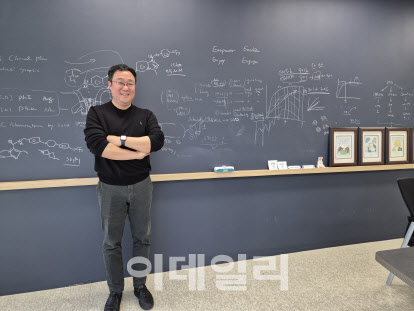 | | Kiyoun Nam, CEO of Qurient, at the company’s headquarters in Pangyo on January 21 (Photo=Edaily, reporter Na Eun-kyung) |
|
ADC therapy combines an antibody with a powerful cytotoxic drug, delivering it directly to tumor cells while minimizing harm to healthy tissue. Qurient is developing a dual payload ADC that incorporates its proprietary CDK7 inhibitor (Q901) to reduce drug resistance and extend therapeutic durability.
Recently, the company signed a licensing deal with Synaffix, a subsidiary of the global biomanufacturing giant Lonza, to adopt its Exatecan-based payload and linker technologies. These allow the drug to be released precisely within cancer cells, improving potency and safety.
Kim A-young, an analyst at Daishin Securities, said:“By integrating Synaffix’s technology, Qurient will complete a CDK7 inhibitor-based dual payload ADC platform. This approach could overcome the resistance problems seen in single-payload ADCs and enhance treatment efficacy.”
She added that with Lonza’s production and technical support, development speed and quality will improve, paving the way for faster tech transfer and commercialization.
Seo Geun-hee, an analyst at Samsung Securities, noted:“Qurient’s CDK7 inhibitor Q901 could be the key to resolving ADC resistance, as it may block the DNA replication mechanisms that drive tumor adaptation.”Qurient is currently conducting preclinical studies on QP101, a HER2-targeting dual payload ADC that combines Q901 with a Topo I inhibitor.
Kim added, “QP101 has shown a better balance between efficacy and safety, and related data are expected to be presented at an upcoming conference in the fourth quarter.”
Samsung Biologics, Strong Earnings Outlook Samsung Biologics surged more than 9% during trading on Oct. 15, closing at \1,127,000, after briefly touching \1,131,000 intraday.
Analysts attributed the rally to favorable foreign exchange rates, full operation of Plant 4, and milestone revenue from Samsung Bioepis.
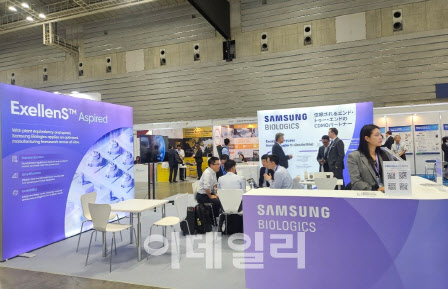 | | Samsung Biologics booth at “Bio Japan 2025” (Photo = Samsung Biologics) |
|
Heo Hye-min of Kiwoom Securities forecast that operating profit for Q3 would reach \646.2 billion, up 91% year-on-year and about 28% above market consensus, citing “a favorable exchange rate, milestone inflows, and leverage from full utilization of Plant 4.”
Lee Hee-young of Daishin Securities added that Q3 sales and operating profit were projected at \1.64 trillion and \598.2 billion, up 38% and 77% year-on-year respectively.
“With additional contract wins, visibility for Plant 6 construction, and U.S. expansion plans, Samsung Biologics’ valuation could rise further,” she said.
Lee Ji-soo of Daol Investment & Securities also noted, “Earnings are expected to exceed market expectations in Q3 and remain strong in Q4 thanks to Plant 4’s full operation. After the planned spin-off, the company’s management structure will stabilize, and global production strategies, including potential U.S. facilities, will become clearer.”
Samsung Biologics is set to finalize its spin-off of CDMO and new drug development divisions on Oct. 17. The market anticipates new announcements on Plant 6 construction and U.S. expansion plans thereafter.
With the recent U.S. BioSecure Act amendment under the National Defense Authorization Act (NDAA), analysts say the company could benefit from a surge in domestic biomanufacturing demand in the U.S.
Vigencell’s Brain Tumor Breakthrough? Vigencell announced that it will unveil preclinical results for its brain tumor therapy candidate VC302 at ESMO 2025, one of the world’s largest oncology congresses, held in Berlin from Oct. 17 to 21.
The company’s stock closed 8.56% (\285) higher at \3,615, buoyed by investor expectations ahead of the presentation.
The study, conducted jointly with Professor Ji-hoon Phi’s pediatric neurosurgery team at Seoul National University Hospital, tested the anticancer efficacy of GD2 CAR-iNK cells. natural killer (NK) cells engineered with GD2-targeted chimeric antigen receptors (CARs).
In both 3D spheroid tumor models and glioblastoma mouse models, GD2 CAR-iNK cells demonstrated remarkable tumor-killing ability. Within just four hours, more than 90% of tumor cells were destroyed, while untreated control groups showed no change.
In mice, tumor signals almost disappeared within 150 days, and no notable side effects or weight changes were observed.
Vigencell CEO Ki Pyung-seok stated:“Glioblastoma is a difficult-to-treat tumor with strong stem-cell-like resistance to chemotherapy. This study confirmed that GD2 CAR-NK cell therapy can selectively target and remove these resistant cells. We aim to accelerate the development and clinical entry of VC302, with the goal of global technology transfer in the near future.”


![Investor Sentiment Rebounds, HLB·VUNO·BNC Korea Drive Market Turning Point[K-Bio Pulse]](https://image.edaily.co.kr/images/vision/files/NP/S/2026/09/PS26092900352b.jpg)

![바람 잘 날 없는 K바이오…오름 ‘임상 중단 쇼크’에 下[바이오 맥짚기]](https://image.edaily.co.kr/images/vision/files/NP/S/2026/09/PS26092100095b.jpg)
![[바이오스터디] AI로 꿀잠 자는 방법 알려드립니다...침실에서 병원까지 데이터로 잠을 분석하는 에이슬립 (이동헌 대표)](https://i.ytimg.com/vi/MM7dtvyr9Go/mqdefault.jpg)