Unauthorized reproduction or distribution is illegal and subject to criminal penalties.
Pharm Edaily enforces a zero-tolerance policy and will take strict action.
[Song Young Doo, Edaily Reporter] G2G Bio and ImmuneOncia posted notable gains on Monday, while ABL Bio shares tumbled. G2G Bio rose more than 10% on expectations that competition among long-acting injectable technologies in the global obesity drug market is entering a phase of differentiation. ImmuneOncia hit the daily upper limit after announcing an expansion of its next-generation CD47 antibody program into pancreatic cancer. In contrast, ABL Bio came under heavy selling pressure after financial authorities raided the company over allegations that employees traded shares using undisclosed information.
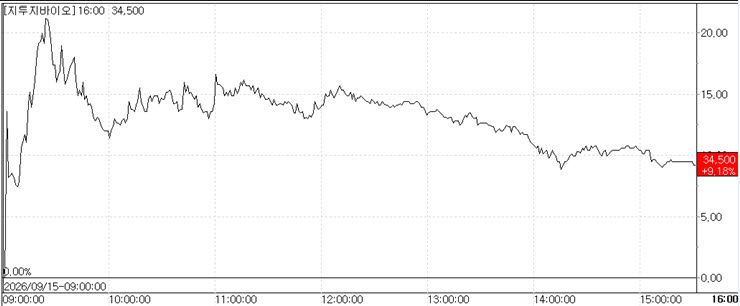 | | G2G Bio stock price trend.(Source=KG Zeroin MP Doctor) |
|
Novo-Ascendis Split Lifts Long-Acting Drug Delivery Stocks According to KG Zeroin‘s MP Doctor, formerly MarketPoint, G2G Bio rose 9.18%, or 2,900 won, from the previous session to 34,500 won on Sept. 15. Other companies developing long-acting drug delivery technologies also gained, with Peptron climbing 8.41% to 150,800 won and Inventage Lab rising 1.20% to 25,250 won.
The rally in long-acting drug delivery companies followed the termination of a partnership between Novo Nordisk and Ascendis Pharma.
Ascendis said on Sept. 14, local time, that it would end its collaboration with Novo Nordisk in metabolic and cardiovascular diseases. As a result, the development, manufacturing and commercialization rights to candidates using Ascendis’ TransCon technology, including once-monthly semaglutide, will revert to Ascendis.
Neither Novo Nordisk nor Ascendis disclosed a specific reason for terminating the partnership. Ascendis said it plans to continue developing the returned once-monthly semaglutide program for obesity and type 2 diabetes.
Still, the fact that Novo Nordisk, one of the global leaders in obesity treatments, ended its partnership involving a long-acting platform has drawn considerable market attention. With once-weekly drugs such as Wegovy and Mounjaro dominating the market, the next stage of competition is shifting toward once-monthly or even longer-acting formulations. This has intensified scrutiny over which drug delivery technologies can ultimately make it to commercialization.
Among Korean companies, G2G Bio showed the strongest market reaction. The company owns InnoLAMP, a platform that encapsulates drugs in biodegradable polymer microspheres for sustained release. Its flagship program is GB-7001, a once-monthly semaglutide candidate.
For long-acting injectables, competitiveness depends heavily on preventing excessive drug release immediately after administration and maintaining stable blood concentrations throughout the dosing period. This is particularly important for GLP-1 therapies, where gastrointestinal adverse events such as nausea and vomiting are common and limiting sharp increases in drug concentration is an important development objective.
G2G Bio highlights this feature as one of its competitive advantages. According to data released by the company, a clinical pharmacokinetic, or PK, simulation based on preclinical data showed a peak-to-trough ratio of 1.3 for GB-7001. That compares with 1.8 for Wegovy and Ozempic and 2.0 for Ascendis‘ semaglutide, according to comparison data presented by G2G Bio. A lower ratio indicates less fluctuation in blood drug concentrations over the dosing interval.
“Microsphere-based technology appears to be gaining recognition in the market for its competitiveness among long-acting injectable approaches,” a G2G Bio official said. “For long-acting peptide formulations, it is important to achieve sufficient drug loading while maintaining stable release.”
Pancreatic Cancer Expansion Sends ImmuneOncia to Daily Limit ImmuneOncia surged 29.94%, or 810 won, to 3,515 won, hitting the daily upper limit. The rally followed news that the company is expanding the development of its next-generation CD47 antibody candidate, IMC-002, into pancreatic cancer, one of the most difficult cancers to treat.
ImmuneOncia announced that it received approval from South Korea’s Ministry of Food and Drug Safety to amend its Phase 1b clinical trial protocol for IMC-002. The amendment adds a cohort of patients with pancreatic ductal adenocarcinoma, or PDAC, to the ENBRIGHT trial, which is evaluating the safety and efficacy of IMC-002 in patients with advanced cancers who have failed standard treatments.
The addition expands the indications under development for IMC-002 from liver, breast and biliary tract cancers to pancreatic cancer. The new PDAC cohort will evaluate IMC-002 in combination with lenvatinib, a multi-targeted tyrosine kinase inhibitor.
CD47 acts as a so-called “don‘t eat me” signal that cancer cells use to evade attacks by macrophages. IMC-002 blocks this signal, allowing macrophages to engulf cancer cells. ImmuneOncia aims to further enhance cancer cell phagocytosis by combining IMC-002 with lenvatinib.
According to the company, an in-vitro study using the BxPC3 pancreatic cancer cell line showed that combining IMC-002 with lenvatinib increased macrophage-mediated cancer cell phagocytosis compared with either treatment alone. However, as the findings have so far been demonstrated only at the cellular level, whether the same synergistic effect can be reproduced in pancreatic cancer patients remains to be established in clinical trials.
ImmuneOncia plans to begin enrolling patients in the pancreatic cancer cohort at Samsung Medical Center in October.
“Based on IMC-002’s favorable safety profile and its synergy with lenvatinib, we aim to successfully conduct this trial and offer a new treatment option for pancreatic cancer patients while using the program as a key stepping stone toward a global licensing deal,” ImmuneOncia CEO Kim Heung-tae said.
Did Employees Buy Ahead of Licensing Deals? ABL Bio Falls 8% ABL Bio fell 8.47%, or 5,500 won, to close at 59,400 won. The decline came after financial authorities launched a compulsory investigation into allegations that company employees used undisclosed information to trade ABL Bio shares.
A joint task force comprising the Financial Services Commission, the Financial Supervisory Service and the Korea Exchange raided ABL Bio‘s headquarters in Seoul’s Gangnam district as well as the residences of employees involved in the case.
Authorities suspect that around 10 employees and other individuals purchased ABL Bio shares before the company publicly disclosed a licensing deal with a global pharmaceutical company, then sold th
shares after the announcement, generating about 1 billion won in illicit gains.
Authorities have not disclosed which licensing deal is under investigation. In April last year, ABL Bio signed a licensing agreement with GSK worth up to 4.11 trillion won for its Grabody-B platform. In November of the same year, it announced a licensing and research collaboration with Eli Lilly worth up to $2.562 billion. ABL Bio shares rose sharply following both announcements.
The key issue is not the raid itself, but how far the investigation will extend. If the case is ultimately found to involve individual employees who personally exploited information obtained through their work, the impact on the company‘s business could remain limited.
The implications would be considerably greater, however, if senior executives responsible for licensing, legal affairs, investor relations or regulatory disclosures were involved, or if authorities find that undisclosed information was repeatedly used in connection with multiple licensing deals. Such findings could turn the case from individual misconduct into a broader issue involving the company’s internal controls.
The raid itself does not establish wrongdoing by ABL Bio or its employees. The task force is expected to examine seized messages, emails and stock-trading records to determine who obtained information about the licensing deals, when they obtained it and whether that information was connected to subsequent share transactions.
“We are currently reviewing the specific facts surrounding the investigation, and no decision has yet been made regarding whether the company will issue an official statement,” an ABL Bio official said.

![Orum Loses Sole Clinical Asset After BMS Return[K-Bio Pulse]](https://image.edaily.co.kr/images/vision/files/NP/S/2026/09/PS26091800261b.jpg)


![[단독]지노믹트리, 대장암 진단키트 中 NMPA 허가](https://image.edaily.co.kr/images/vision/files/NP/S/2026/09/PS26091801277b.jpg)