Unauthorized reproduction or distribution is illegal and subject to criminal penalties.
Pharm Edaily enforces a zero-tolerance policy and will take strict action.
[Kim Saemi, Edaily Reporter] South Korean biotech stocks came under pressure on Oct. 2, with AprilBio Co., Ltd. plunging 20% despite additional Phase 2a data for atopic dermatitis candidate APB-R3. Peptron Inc. also fell sharply as the company repeatedly tempered expectations for a follow-on deal with Eli Lilly ahead of Oct. 7, a key date tied to their research collaboration.
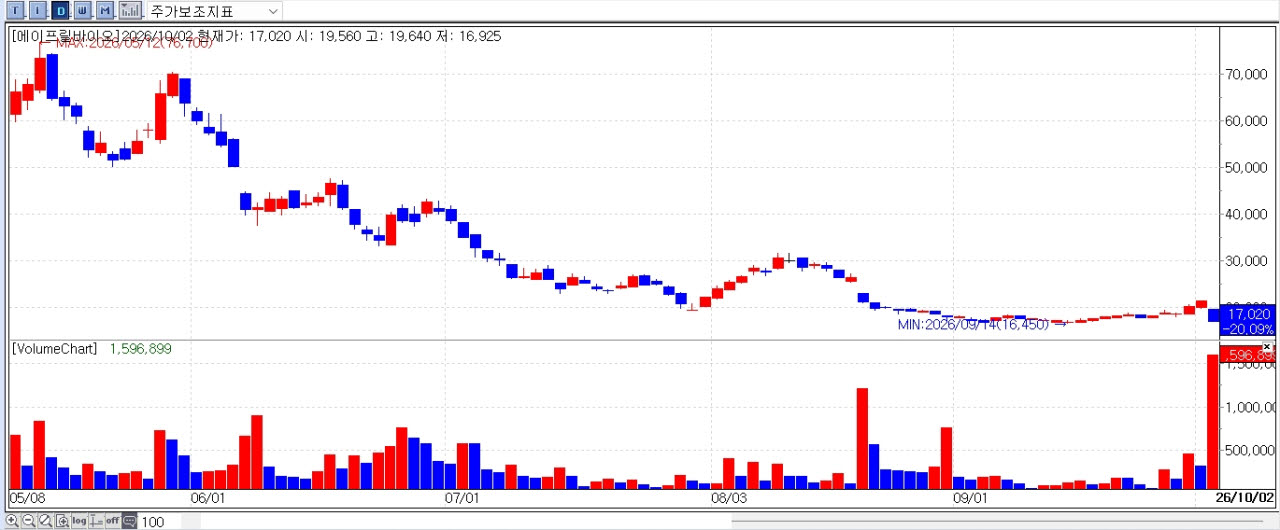 | | Recent share-price trend of AprilBio (Source: KG Zeroin MP DOCTOR) |
|
AprilBio Plunges 20% as EVO301 Data Fall Short of Market Expectations According to KG Zeroin‘s MP DOCTOR, AprilBio closed at 17,020 won, down 20.09%, despite additional clinical data supporting the efficacy of APB-R3, licensed to U.S.-based Evommune Inc.
Evommune on Oct. 1 unveiled detailed Phase 2a results for EVO301, formerly APB-R3. The candidate was administered only twice, at weeks 0 and 4, but achieved a mean 55% improvement in Eczema Area and Severity Index, or EASI, at week 12, versus 22% for placebo. The treatment effect continued to widen through eight weeks after the final dose, with no treatment-related severe or serious adverse events reported.
Evommune said the results established proof of concept and plans to advance EVO301 into a Phase 2b study with repeat subcutaneous dosing and dose optimization in mid-2027. For AprilBio, the readout also demonstrated clinical efficacy for another candidate based on its SAFA platform following the discontinuation of APB-A1 for thyroid eye disease.
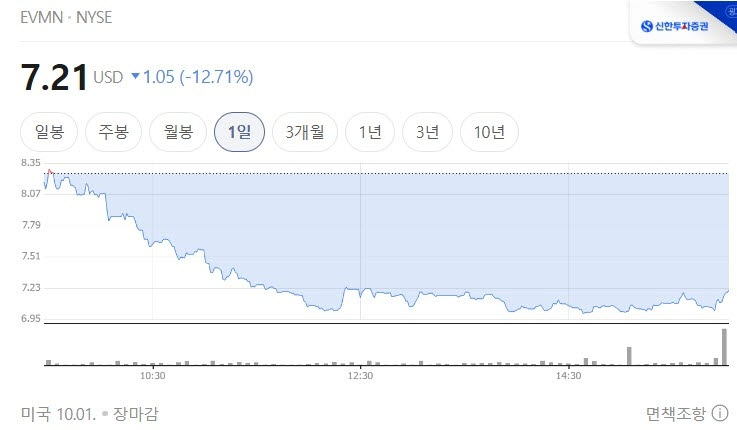 | | Evommune share-price movement on Oct. 1, local time (Source: Naver Pay Securities) |
|
Investors, however, appeared less impressed. Evommune shares plunged 12.71% to $8.26, giving the company a market capitalization of about $262 million, or 353.7 billion won. AprilBio likewise sank 20.09%, reducing its market capitalization to 469.1 billion won.
Attention centered on EVO301’s EASI-75 response rate of 29%, versus 9% for placebo. AprilBio argued that the result should be viewed in light of the limited two-dose regimen and highlighted a placebo-adjusted mean EASI improvement of 33 percentage points, similar to figures reported in Dupixent trials.
By comparison, Dupixent achieved EASI-75 rates of 51% and 44% in its SOLO 1 and SOLO 2 trials, versus 15% and 12% for placebo. Direct comparisons are limited, however, as EVO301 was evaluated with two doses over 12 weeks in Phase 2a, while Dupixent involved repeated dosing over 16 weeks in Phase 3.
AprilBio said the selloff appeared excessive, arguing that investors viewed the data as falling short of showing clear superiority over competing therapies rather than as a clinical failure. The company expects an optimized dosing regimen in Phase 2b to potentially improve efficacy.
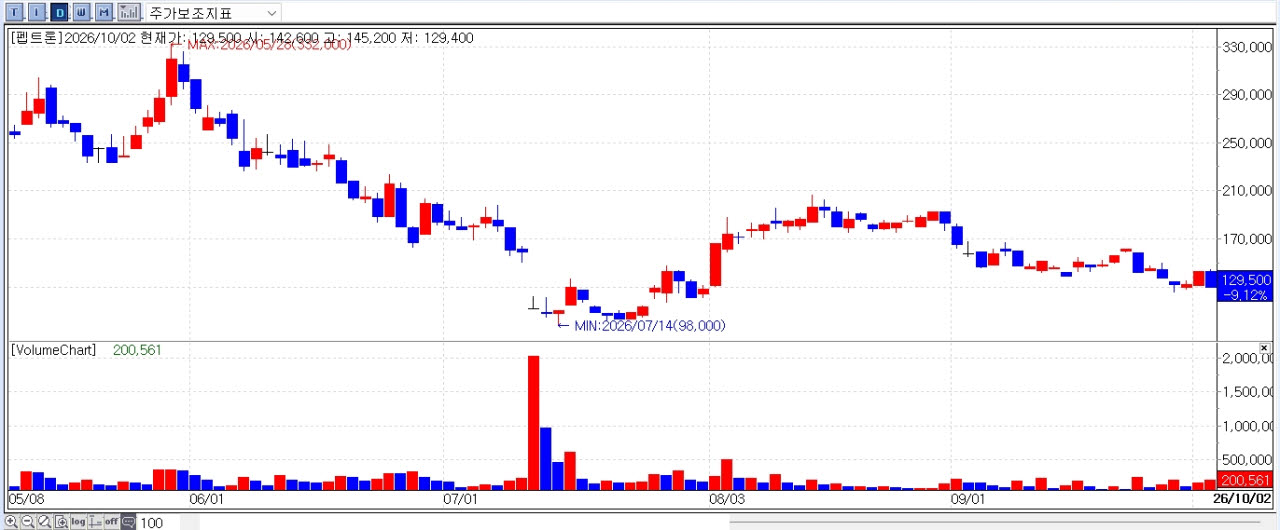 | | Recent share-price trend of Peptron (Source: KG Zeroin MP DOCTOR) |
|
Peptron Tempers Lilly Deal Expectations Ahead of Oct. 7 Peptron closed at 129,500 won, down 9.12%, reversing much of the previous day‘s rebound as investors weighed uncertainty over its collaboration with Eli Lilly.
The two companies signed a technology evaluation agreement on Oct. 7, 2024, to assess Peptron’s SmartDepot long-acting drug-delivery technology with Lilly‘s peptide compounds. With the evaluation period described as lasting “up to 24 months,” investors have viewed Oct. 7, 2026, as a potential milestone for a follow-on commercial agreement.
Peptron, however, has repeatedly sought to temper those expectations. It said Sept. 12 that Oct. 7 relates to the basic term of the research agreement and is not a deadline for signing a commercial deal.
The company then issued shareholder FAQs on Sept. 30 and Oct. 1, reiterating that the Lilly collaboration remains ongoing while stressing that the 24-month period is merely the maximum evaluation period.
Peptron also distanced several developments from Lilly. It said PT403 and PT404 are independently developed SmartDepot pipelines, while a recently allowed Korean patent for a long-acting GLP-1 formulation was filed solely by Peptron and is not a new outcome of the Lilly collaboration.
The company also stressed that its second Osong plant is not being built on the assumption of a licensing agreement or commercial manufacturing volumes from any specific global pharmaceutical company.
“It raises questions as to why the company is repeating previous explanations at this particular point while distancing various developments from Lilly,” a biotech industry official said. “If the lengthy evaluation ultimately fails to lead to a commercial agreement, Peptron could end up having committed significant time without securing an upfront payment.”

![AprilBio Plunges 20%; Peptron Tempers Lilly Deal Hopes[K-Bio Pulse]](https://image.edaily.co.kr/images/vision/files/NP/S/2026/10/PS26100600390b.jpg)

![에이프릴 'APB-R3' 데이터에 20%↓…‘릴리 기대감’ 선 긋는 펩트론[바이오 맥짚기]](https://image.edaily.co.kr/images/vision/files/NP/S/2026/10/PS26100600387b.jpg)

![美 의약품 관세 발효…삼성에피스, 테바와 시밀러 동맹 확대 [바이오 주간 결산]](https://image.edaily.co.kr/images/vision/files/NP/S/2026/10/PS26100500035b.jpg)