Unauthorized reproduction or distribution is illegal and subject to criminal penalties.
Pharm Edaily enforces a zero-tolerance policy and will take strict action.
[Min Ji-Son, Edaily Reporter] On Oct. 29, South Korean pharmaceutical, biotech and healthcare stocks advanced on company-specific developments, including clinical data, expanded treatment indications and new product launches. CellBion gained as investors revisited previously disclosed clinical results for its prostate cancer drug candidate, while ROKIT Healthcare surged after announcing an application to expand the approved indications of its cartilage regeneration platform in Europe. Hanmi Pharmaceutical also rebounded as prescriptions began for its domestically developed obesity treatment, Epe.
CellBion rises as 47.4% response rate draws attention 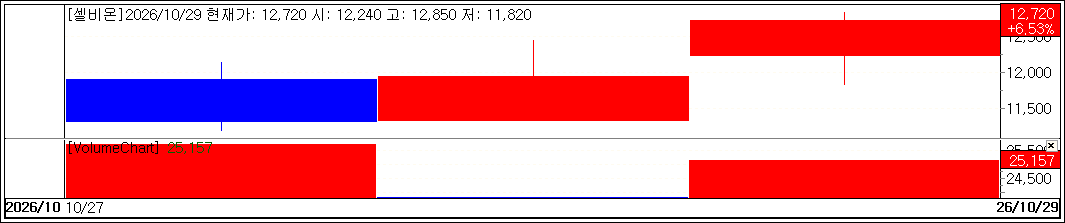 | | CellBion stock trend on Oct. 29.(Image= MP Doctor) |
|
According to KG Zeroin‘s MP Doctor platform, CellBion closed at 12,720 won on the KOSDAQ, up 6.53%, or 780 won, from the previous session. Shares reached an intraday high of 12,850 won.
The gain appeared to reflect renewed investor interest in previously reported clinical data for CellBion’s prostate cancer treatment candidate, focubotide satetraxetan (Lu-177-DGUL).
Although the company did not release new clinical results, attention turned to differences in objective response rates (ORR) depending on the patient population analyzed.
CellBion previously reported an ORR of 35.9% among 78 efficacy-evaluable patients in its domestic Phase 2 trial. ORR measures the proportion of patients whose tumors either disappear completely or shrink by a predefined amount on imaging.
The company subsequently provided a separate analysis based on its clinical study report (CSR), showing an ORR of 47.4% among patients with measurable lesions.
The difference reflects the composition of the two analysis populations. The higher figure was calculated only among patients whose lesions could be measured on imaging, rather than the broader efficacy-evaluable population.
The 47.4% response rate also drew attention in comparison with data released by fellow South Korean radiopharmaceutical developer FutureChem.
FutureChem recently reported an ORR of 38.9% in a U.S. Phase 2a trial of FC705, its prostate cancer radiopharmaceutical candidate.
CellBion‘s response rate in the measurable-lesion subgroup was numerically higher, although differences in trial populations and study designs mean the figures cannot establish comparative efficacy.
Recent investor relations activities may also have contributed to the rally. CellBion has been meeting institutional investors, including securities firms and asset managers, to explain its clinical findings.
“We explained the clinical results and evaluation criteria to institutional investors, and we believe those discussions may also have influenced today’s share price movement,” a CellBion official said.
ROKIT Healthcare surges on European cartilage indication expansion filing 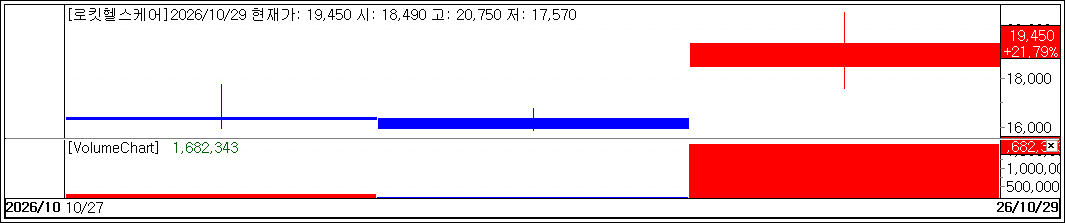 | | ROKIT Healthcare stock trend on Oct. 29.(Image= MP Doctor) |
|
ROKIT Healthcare closed at 19,450 won, up 21.79%, or 3,480 won, from the previous session.
The rally followed the company‘s announcement that it had completed an application to expand the scope of its existing European medical device certification to include knee cartilage defects.
ROKIT Healthcare said it submitted an amendment application under the European Union’s Medical Device Regulation (EU MDR) last month to add knee cartilage defects as an indication for its artificial intelligence-based cartilage regeneration platform, Dr. INVIVO AI Regen KIT.
The company expects a regulatory decision between the end of this year and early next year.
If approved, ROKIT Healthcare plans to begin marketing and sales activities targeting European medical institutions in the first quarter of next year as part of its expansion into the European market.
The application seeks to broaden the scope of an existing certification rather than establish a new approval from scratch.
However, the review remains ongoing, and both the anticipated decision date and commercialization timeline depend on the final regulatory outcome.
ROKIT Healthcare cited four-year follow-up clinical data collected in Egypt as supporting evidence for the expanded indication.
According to the company, tissue examinations identified cartilage resembling normal hyaline cartilage, while assessments of pain and joint function also showed improvements.
Still, questions remain over the strength of the supporting clinical evidence.
A related Egyptian study published in a scientific journal in 2023 followed 10 patients for 12 months in a single-arm, open-label design. The absence of a control group limits the extent to which treatment effects can be established.
Industry observers said the longer-term findings warrant further examination, particularly in assessing the durability and clinical significance of the reported outcomes.
“Because regulatory approval has not yet been granted, it is difficult to treat the application alone as a definitive positive development,” one industry official said. “Even after approval, investors will need to see whether the technology achieves actual adoption and generates sales in European medical practice.”
Hanmi Pharmaceutical rebounds as Epe prescriptions begin 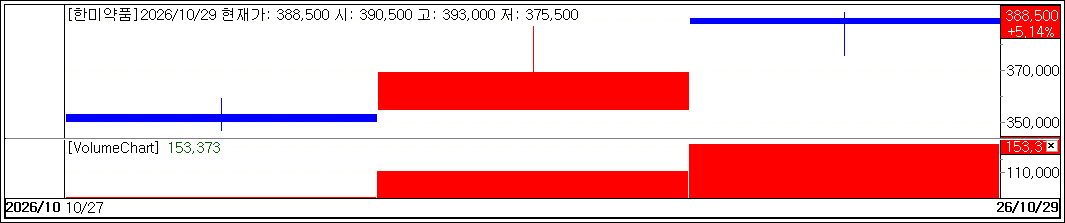 | | Hanmi Pharmaceutical stock trend on Oct. 29.(Image= MP Doctor) |
|
Hanmi Pharmaceutical closed at 388,500 won on the KOSPI, up 5.14%, or 19,000 won, from the previous session.
The rebound came as prescriptions began for Epe, the company‘s domestically developed obesity treatment, raising expectations for its commercial performance.
With Hanmi shares having undergone a substantial correction following regulatory approval, the product launch also appeared to attract bargain hunting.
Epe received marketing authorization in South Korea on Oct. 7.
In a Phase 3 trial involving 448 Korean patients with obesity, the treatment demonstrated a 9.02% weight reduction relative to placebo after 40 weeks.
Its commercial prospects will depend in part on how widely medical institutions adopt the product and whether patient prescriptions increase following launch.
Pricing is expected to be a key competitive factor.
Because obesity treatment typically requires continued medication over an extended period, out-of-pocket costs can influence both treatment selection and patients’ ability to remain on therapy.
Epe‘s supply price for the initial four weeks has been set at 129,800 won, potentially lowering the financial barrier for patients beginning treatment.
However, the supply price for the 10-mg maintenance dose is 299,200 won, meaning costs will vary as patients move through dose escalation.
Analysts said patients and physicians will need to weigh the treatment’s effectiveness against its ongoing cost rather than focusing solely on the introductory price.
Another potential advantage is that Epe‘s weight-loss efficacy was demonstrated in a clinical trial specifically involving Korean patients.
The arrival of a domestically developed obesity drug supported by local clinical data could broaden treatment options for both patients and healthcare providers.
“We will work to establish Epe successfully in the domestic market by improving treatment accessibility through rigorous quality control and a reasonable pricing structure,” a Hanmi Pharmaceutical official said.
“We will also strive to support healthy weight loss and integrated management of metabolic diseases, ultimately helping improve the quality of life of patients living with obesity.”