Unauthorized reproduction or distribution is illegal and subject to criminal penalties.
Pharm Edaily enforces a zero-tolerance policy and will take strict action.
[Kim Jin Soo, Edaily Repoeter] Vaxcell-bio drew strong investor interest after reporting preclinical results showing that its experimental chimeric antigen receptor T-cell, or CAR-T, therapy demonstrated antitumor activity in solid tumors, an area where CAR-T treatments have historically struggled.
Meanwhile, shares of Alteogen fell amid concerns over potential U.S. drug price cuts affecting Keytruda Qlex, the subcutaneous version of Merck‘s blockbuster cancer drug, as well as an ongoing patent dispute between Merck and Halozyme Therapeutics. Seegene also suffered a sharp decline after reporting quarterly earnings that fell short of market expectations.
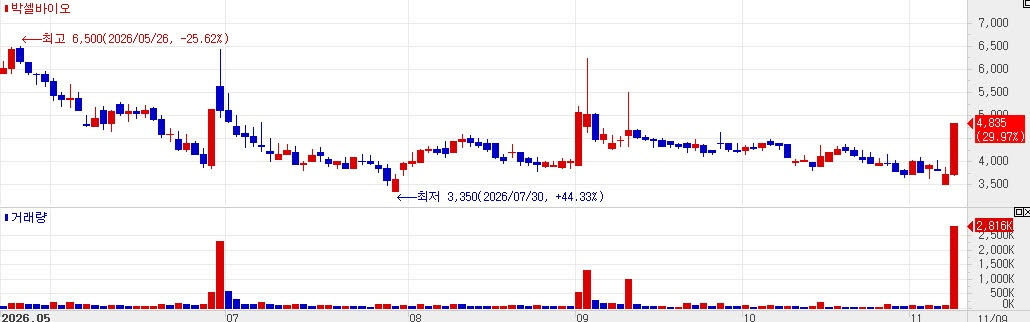 | | Vaxcell-bio stock trend. (KG Zeroin) |
|
Vaxcell-bio Hits Daily Limit on Promising Pipeline Data According to MP Doctor, a financial data service operated by KG Zeroin and formerly known as Market Point, Vaxcell-bio shares hit the daily upper price limit during morning trading and closed at 4,835 won. The rally was largely attributed to promising preclinical results from the company’s next-generation CAR-T therapy, which demonstrated antitumor activity against solid tumors.
Vaxcell-bio announced that it had presented research findings on two experimental cell therapies at the Society for Immunotherapy of Cancer‘s 2026 annual meeting, or SITC 2026. The presentations covered VCB-1204, a dual-target CAR-T therapy for solid tumors, and VCB-1201, a CAR-MIL therapy being developed for multiple myeloma.
The most notable findings involved VCB-1204 and its potential application in solid tumors. Although CAR-T therapies have demonstrated substantial clinical benefits in blood cancers, their development for solid tumors has faced significant obstacles, including heterogeneous tumor antigen expression and immunosuppressive tumor microenvironments that limit immune cell activity.
VCB-1204 is designed to address these challenges by simultaneously targeting PD-L1 and EphA2. Vaxcell-bio reported antitumor activity following a single intravenous administration in animal models of liver, gastric and ovarian cancers.
In particular, the medium-dose group in the liver cancer model achieved a 100% complete response rate in both male and female animals. The therapy also suppressed tumor growth in gastric and ovarian cancer models.
The company also reported encouraging findings for VCB-1201, a CAR-MIL therapy targeting BCMA for the treatment of multiple myeloma. The therapy is manufactured by collecting immune cells from patients’ bone marrow and genetically modifying them to express a BCMA-targeting CAR.
The latest research demonstrated manufacturing reproducibility through a 10-day large-scale cell expansion process. The engineered cells also maintained their cancer-killing activity following repeated exposure to tumor cells.
Vaxcell-bio is preparing investigational new drug applications for both candidates. However, the reported antitumor effects were observed in preclinical studies, and further clinical trials will be required to determine whether similar efficacy can be achieved in patients.
Alteogen falls on U.S. drug pricing concerns and Halozyme patent dispute Alteogen shares plunged 16.46% to close at 167,500 won, as investors weighed the potential impact of U.S. drug pricing policies and an expanding patent dispute between its partner Merck, known as MSD outside the United States and Canada, and Halozyme Therapeutics.
On Nov. 5, the U.S. Centers for Medicare & Medicaid Services, or CMS, announced that certain combination formulations incorporating ingredients such as hyaluronidase to change a drug‘s route of administration would be treated alongside the original products for purposes of Medicare drug price negotiations. The policy will apply beginning with negotiations for prices taking effect in 2029.
The decision raised concerns that Keytruda Qlex, which uses Alteogen’s subcutaneous drug delivery technology, could become subject to Medicare price negotiations, potentially affecting its commercial outlook.
Alteogen, however, said it expects the actual impact of negotiated price reductions on pharmaceutical companies‘ revenue to be relatively limited.
“Although the official discounts for the 10 drugs subject to price reductions this year range from 38% to 79%, we estimate that the actual revenue impact will generally remain within 20% after accounting for rebates and other factors,” an Alteogen official said.
“Keytruda Qlex generated $830 million in sales in the third quarter, and Merck has maintained its target of increasing the subcutaneous formulation’s share of Keytruda administrations in the U.S. to 30% to 40% by the end of 2027,” the official added.
The company also emphasized the strategic importance of subcutaneous drug delivery technology for global pharmaceutical companies.
“Converting intravenous drugs to subcutaneous formulations meets the pharmaceutical industry‘s strategic needs by improving patient convenience, differentiating products and extending patent-based market exclusivity,” the official said. “We will continue expanding our global partnerships and commercialization efforts.”
Additional pressure on Alteogen shares came from the expanding European patent dispute over Keytruda Qlex, which uses the company’s subcutaneous formulation technology.
In September, Halozyme sought a preliminary injunction in Italy against Merck‘s local subsidiary and BSP Pharmaceuticals, the Italian contract manufacturer responsible for producing the drug’s finished dosage form. The first hearing is scheduled for Dec. 2.
The litigation has raised concerns that the dispute could extend beyond European sales restrictions to affect Keytruda Qlex‘s manufacturing and supply network.
“We believe the stock decline reflects a combination of factors, including concerns over drug price reductions and the patent dispute between our partner Merck and Halozyme,” an Alteogen official said.
Seegene tumbles as third-quarter earnings miss expectations
Seegene shares dropped 20.65% from the previous session to close at 24,600 won, as investors reacted negatively to the company’s third-quarter financial results released last week.
On Nov. 6, Seegene reported consolidated third-quarter revenue of 123.1 billion won and operating profit of 11.6 billion won, representing year-over-year increases of 8.4% and 21.2%, respectively.
Despite the annual growth, operating profit fell 38.1% short of the market consensus estimate of 18.8 billion won, highlighting a substantial gap between analysts‘ expectations and actual performance.
The company’s earnings also deteriorated sharply on a sequential basis. Revenue declined 9.4% from the previous quarter, while operating profit plunged 46.1%, indicating that profitability weakened considerably faster than sales.
Seegene also swung to a net loss, reporting a third-quarter loss of 18.8 billion won compared with a net profit of 26 billion won in the preceding quarter.
Seegene experienced rapid growth during the COVID-19 pandemic as demand for diagnostic test kits surged. Since then, the company has been working to establish a more stable revenue base centered on non-COVID diagnostic products while rebuilding profitability.
“Although our business continues to show growth, we believe the stock decline was driven by the gap between market expectations and our actual financial results,” a Seegene official said.