Unauthorized reproduction or distribution is illegal and subject to criminal penalties.
Pharm Edaily enforces a zero-tolerance policy and will take strict action.
[NA Eun-kyung, Edaily Reporter] Hair-loss treatments are emerging as a new investment theme in global stock markets following the obesity drug boom. In South Korea, expectations for expanded national health insurance coverage have sent related stocks sharply higher, although the investment case varies widely from companies already selling treatments to firms still in early-stage research.
Peptron, meanwhile, extended its sharp decline for a second session as the end of its technology evaluation period with Eli Lilly and Co. approaches, despite no disclosure of any material negative development.
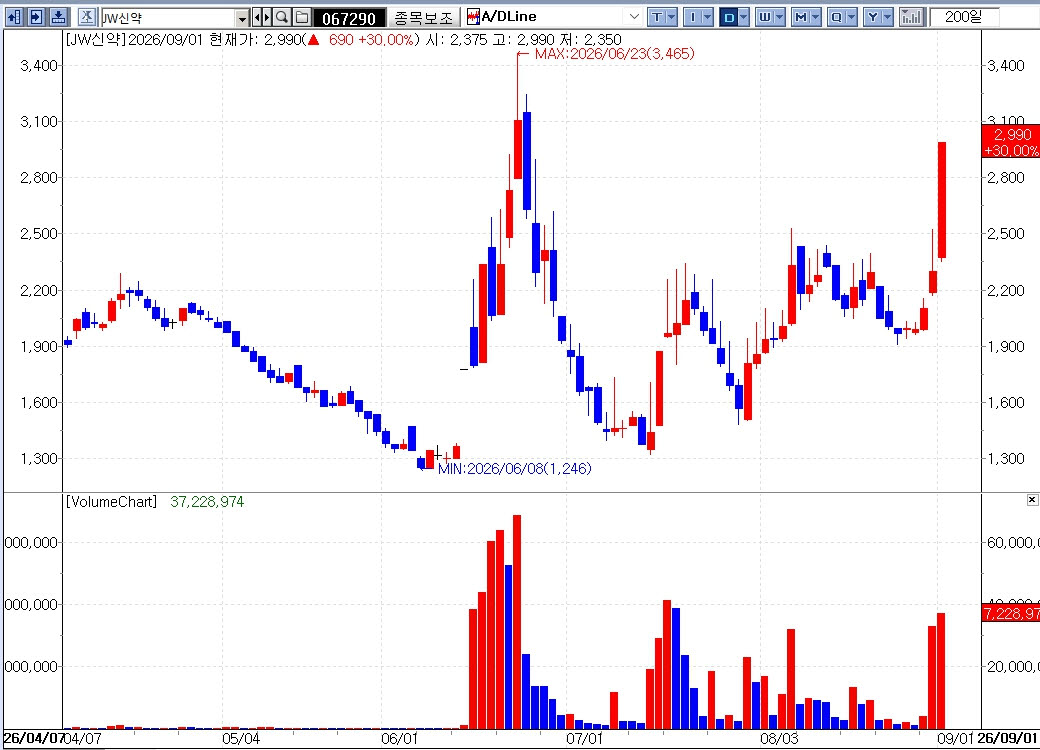 | | Stock price trend of JW Shinyak Corporation. Its shares have risen whenever hair-loss treatments have attracted market attention. (Source: KG Zeroin MP DOCTOR) |
|
Insurance Hopes Fuel Hair-Loss Stocks In South Korea, discussion over expanding national health insurance coverage for hair-loss treatments has fueled investor interest. The government said in June that it would pursue broader coverage, particularly for younger people. But it later canceled a public debate scheduled for July 4 amid controversy over national health insurance spending priorities.
The Ministry of Health and Welfare has also said the issue requires a long-term review, leaving the prospects for implementation this year uncertain.
Despite the policy uncertainty, JW Shinyak and Hyundai Pharm jumped 30.0% and 29.9%, respectively, hitting their daily upper limits Tuesday, according to KG Zeroin‘s MP Doctor, formerly MarketPoint.
Both companies already sell hair-loss treatments, meaning they could see a relatively quick revenue impact if insurance coverage is expanded.
JW Shinyak sells oral finasteride and dutasteride products as well as topical minoxidil. Hyundai Pharm markets Minoxyl, a topical minoxidil treatment.
JW Shinyak could have a relative advantage if coverage focuses on prescription drugs such as finasteride and dutasteride while excluding over-the-counter topical minoxidil.
Expanded coverage, however, would not necessarily boost profitability. Prescription volumes could increase, but margins may fall if reimbursement prices are set below current non-reimbursed prices.
Withus, Bioneer and Samick Offer Different Bets Withus Pharmaceutical, Bioneer and Samick Pharmaceutical represent different hair-loss investment cases because their businesses range from drug manufacturing to cosmetics and early-stage research.
Withus Pharmaceutical rose 5.9%. The company is responsible for manufacturing long-acting injectable formulations, including IVL3001, a finasteride-based candidate being developed by Inventage Lab and Daewoong Pharmaceutical, and CKD-843, Chong Kun Dang Pharmaceutical’s Phase 3 dutasteride injectable.
While development and regulatory risks remain, Withus is the closest of the three to potential pharmaceutical commercialization.
Bioneer surged 25.1%. It sells CosmeRNA, an siRNA-based hair-loss relief product, in overseas markets. But CosmeRNA is not directly tied to South Korea‘s national health insurance system, meaning overseas sales and follow-up products are likely to matter more than reimbursement policy.
Samick Pharmaceutical soared 26.7%, but its hair-loss program is much further from commercialization. The company is researching SLIM2401, a long-acting injectable formulation of baricitinib designed for once-monthly administration.
“This is not at a stage where short-term research results would immediately lead to commercialization. It is a mid- to long-term R&D project,” a Samick Pharmaceutical official said.
Samick listed last October through a SPAC merger at a merger price of 7,480 won per share, still above Tuesday’s closing price of 6,830 won despite the day‘s rally.
Peptron Slides as Lilly Evaluation Deadline Nears Peptron fell 9.66% Tuesday to 165,500 won after dropping 4.78% Monday, bringing its two-day decline to about 14%.
No negative disclosure was issued, but institutional and foreign investors sold a net 58,776 shares and 12,423 shares, respectively.
Short-selling volume jumped 46.2% to 75,282 shares Tuesday from 51,483 shares a day earlier. Short sales totaled about 12.79 billion won, accounting for 21.1% of combined trading volume on the Korea Exchange and Nextrade.
While it is difficult to attribute the decline solely to short selling, the rise in short-selling volume for two consecutive sessions may have added downward pressure. Tuesday’s net short position data have not yet been released.
Market watchers said investor anxiety may also reflect the approaching end of Peptron‘s platform technology evaluation agreement with Lilly.
Peptron signed an evaluation agreement with Lilly on Oct. 7, 2024, for SmartDepot, its long-acting drug delivery platform. The evaluation period was initially about 14 months but was extended to a maximum of 24 months in a revised disclosure last December.
Under the current disclosure, the maximum period runs through Oct. 7, increasing investor attention on whether the evaluation will lead to a license-out agreement.
However, the date does not necessarily mean a license-out decision will be announced then. The evaluation schedule could also be revised again depending on discussions between Peptron and Lilly.

![Rokit Healthcare Plunges 20% on FDA Warning Letter to U.S. Partner[K-bio Pulse]](https://image.edaily.co.kr/images/vision/files/NP/S/2026/10/PS26102300285b.jpg)

![윤재호 서울성모병원 교수 “안발셀, ALL 효과 확인…효과 유지가 관건”[전문가 인사이트]](https://image.edaily.co.kr/images/vision/files/NP/S/2026/10/PS26102300368b.jpg)
![레몬헬스케어 上…지투지바이오·올릭스, 빅파마 기술수출 기대감 ↑[바이오 맥짚기]](https://image.edaily.co.kr/images/vision/files/NP/S/2026/10/PS26102200877b.jpg)