Unauthorized reproduction or distribution is illegal and subject to criminal penalties.
Pharm Edaily enforces a zero-tolerance policy and will take strict action.
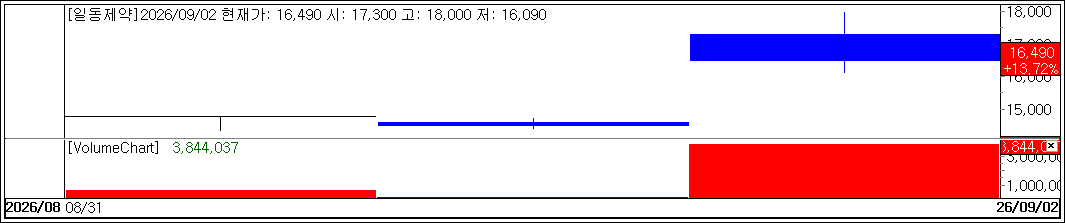 | | Ildong Pharmaceutical stock trend on August 10.(Image= MP Doctor) |
|
[Min Ji-Son, Edaily Reporter] On Sept. 2, Ildong Pharmaceutical emerged as one of the strongest performers among South Korean pharmaceutical and biotech stocks, rising sharply after a court upheld a decision invalidating a use patent related to linagliptin. Investor sentiment was further supported by renewed expectations for a licensing deal involving the company‘s oral obesity drug candidate.
According to KG Zeroin’s MP Doctor platform, Ildong Pharmaceutical closed at 16,490 won on the KOSPI, up 13.72%, or 1,990 won, from the previous session. The stock climbed as high as 18,000 won intraday, briefly pushing its gain above 24%.
The most visible catalyst was a recent Patent Court ruling involving generic versions of linagliptin, a diabetes treatment.
On Aug. 13, the Patent Court dismissed all claims brought by Boehringer Ingelheim against 17 South Korean pharmaceutical companies seeking to overturn an earlier patent tribunal decision.
The disputed patent covers the use of linagliptin in patients with type 2 diabetes who either have cardiovascular disease or are considered at high risk of developing it. The protected patient population includes those with a history of myocardial infarction, coronary artery disease or stroke, as well as elderly patients and those with risk factors such as hypertension, smoking and obesity.
The patent is scheduled to remain in force until November 2031. Although the compound patent covering linagliptin itself expired in June 2024, follow-on patents covering specific uses and patient populations remained in place.
The dispute began in June 2024, when Ildong Pharmaceutical, Boryung, Daewon Pharmaceutical and other domestic drugmakers filed invalidation petitions with the Intellectual Property Trial and Appeal Board.
The companies argued that the follow-on use patent could restrict sales and expansion of their generic products if it remained valid.
After consolidating the cases filed by 17 companies, the tribunal invalidated the patent in April last year. Boehringer subsequently challenged that ruling in the Patent Court, but its claims were again rejected.
Importantly, the ruling does not mean linagliptin lacks efficacy as a diabetes treatment.
Rather, the court found that Boehringer had not sufficiently demonstrated that the drug provided a distinct therapeutic benefit specifically in diabetic patients at elevated cardiovascular risk.
The patent specification included data showing glucose-lowering effects in diabetic animal models and cardiovascular safety in separate cardiovascular disease models. But the court found that it lacked concrete evidence showing therapeutic benefits in the specific high-risk diabetic population covered by the patent.
The court also noted that the specification largely described plans to investigate those effects in future studies rather than presenting “specific and objective experimental results” showing how linagliptin affected cardiovascular risk in those patients.
In other words, the court determined that a plan to test a potential benefit in future clinical studies was not enough to support a patent as though a distinct therapeutic effect had already been established.
The court also rejected the argument that defining high-risk cardiovascular patients as a separate treatment population represented a sufficiently inventive concept.
It noted that it was already widely understood that a substantial proportion of patients with type 2 diabetes either have cardiovascular disease or face elevated cardiovascular risk. Given that DPP-4 inhibitors were already regarded as having relatively favorable cardiovascular safety profiles, the court concluded that a skilled expert could have readily considered using linagliptin in such patients.
Based on those findings, the court ruled that the claimed therapeutic effect was not adequately supported by the patent specification and that the treatment approach lacked sufficient inventive step over existing knowledge.
The decision is seen as reducing some of the legal uncertainty surrounding linagliptin generics in South Korea. Ildong currently sells Linazetin, a linagliptin generic, and Linazetin Duo, a combination product with metformin.
Still, the dispute is not over. Boehringer has until Sept. 4 to appeal the decision to the Supreme Court, meaning the ruling is not yet final.
Nor have all of Boehringer‘s linagliptin-related patents been invalidated. Three formulation patents scheduled to expire in April next year were also challenged by some domestic companies, but the Patent Court rejected those invalidation claims.
Some industry observers cautioned that the patent ruling alone does not fully explain Ildong’s sharp rally.
Other companies involved in the same litigation showed far more muted moves. Boryung and Jeil Pharmaceutical fell 2.21% and 4.56%, respectively, while Daewon Pharmaceutical rose just 1.63%.
“Invalidating one patent is only one step in the commercialization process, and actual sales after launch are a separate issue,” one pharmaceutical industry official said. “Because this case involved multiple drugmakers, it is difficult to attribute the sharp rise in one company‘s stock solely to the ruling.”
The outsized move in Ildong shares may also reflect renewed expectations surrounding ID110521156, its oral glucagon-like peptide-1, or GLP-1, obesity drug candidate.
In a Phase 1 study, the 200-mg dose group showed an average weight reduction of 9.9% after four weeks, with the maximum reduction reaching 13.8%.
Ildong has been exploring licensing and co-development opportunities with global pharmaceutical companies based on the clinical data, including through partnering activities at BIO USA this year.
The company is currently understood to be pursuing follow-on development, including a Phase 2 trial, while continuing discussions over potential licensing-out and co-development agreements.
“Share prices are not something a company can directly control, so without identifying the actual buyers it is difficult to pinpoint a single reason for the move,” another industry official said. “It is more reasonable to view the rally as the result of the patent ruling combining with existing expectations for an obesity drug licensing deal.”


![[단독인터뷰]바이오헤이븐 “BHV-1530, ‘계열 내 최초’ 기대, 릴리 물질 넘어섰다”](https://image.edaily.co.kr/images/vision/files/NP/S/2026/10/PS26102600087b.jpg)
![윤재호 서울성모병원 교수 “안발셀, ALL 효과 확인…효과 유지가 관건”[전문가 인사이트]](https://image.edaily.co.kr/images/vision/files/NP/S/2026/10/PS26102300368b.jpg)
![노보 협력 기대 지투지바이오 급등…노을·퓨쳐켐 상한가[바이오맥짚기]](https://image.edaily.co.kr/images/vision/files/NP/S/2026/10/PS26102600104b.jpg)

![SCL사이언스, 간암·난소암 백신 도전…내년 IND 신청 목표[인베스트 바이오]](https://image.edaily.co.kr/images/vision/files/NP/S/2026/10/PS26102400159b.jpg)