Unauthorized reproduction or distribution is illegal and subject to criminal penalties.
Pharm Edaily enforces a zero-tolerance policy and will take strict action.
[Kim Jin Soo, Edaily Repoeter] D&D Pharmatech shares dropped sharply after it was confirmed that development had been halted on an obesity drug candidate built with the company‘s technology. Coming on the heels of questions about Peptron’s technology evaluation agreement with Eli Lilly and Co., the news has shaken expectations for obesity treatments based on Korean biotech platforms.
Dongwoon Anatech shares rose on news that the company had filed a clinical trial application for its saliva-based glucose meter and would soon release trial results.
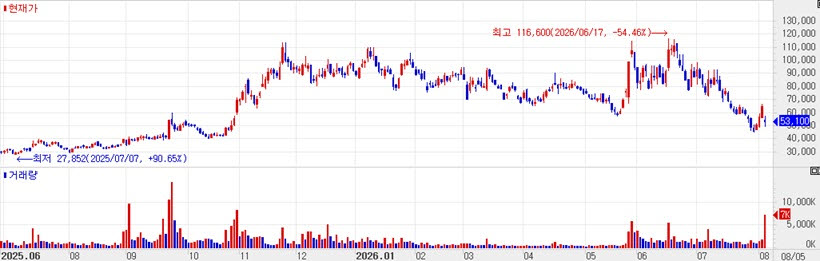 | | D&D Pharmatech Stock Trend. (KG Zeroin) |
|
D&D Pharmatech falls 18% D&D Pharmatech closed at 53,100 won on Aug. 5, down 18.06% from the previous session, according to MP Doctor, the KG Zeroin platform formerly known as Marketpoint. The decline is attributed to news that Metsera‘s obesity pipeline had been cut back.
Pfizer Inc. said Aug. 4 in its second-quarter earnings materials that it had discontinued development of MET-224o, a candidate built on D&D Pharmatech’s ORALINK oral peptide platform, according to industry officials.
D&D Pharmatech licensed six oral obesity drug candidates to Metsera in 2023 for $803.5 million, and Metsera was later acquired by Pfizer. MET-224o is a glucagon-like peptide-1, or GLP-1, receptor agonist that uses ORALINK. Pfizer took over direct development of the candidate when it bought Metsera but halted the program, citing a change in strategy among other reasons. Pfizer said it would continue to pursue GLP-1 candidates through both oral peptides and small molecules.
As the shares slid, D&D Pharmatech moved to contain the damage, saying the discontinuation does not indicate a technical problem with ORALINK and that the partnership remains sound.
Citing confidentiality obligations that limit what it can disclose, the company said Pfizer, a latecomer to the obesity market, is concentrating on products that differentiate themselves from approved drugs. In oral peptides specifically, it is weighting development toward multi-agonists that deliver greater weight loss than single GLP-1s.
“Two oral products from the joint development program entered the clinic, and the strategy of advancing only one of them after early trials had been public before the acquisition,” a D&D Pharmatech official said. “The inclusion of one of those products in this round of discontinuations is entirely foreseeable as an extension of the existing development strategy.” The two pipelines the company referred to are MET-224o and MET-097o.
“Given that Pfizer has said it will continue developing peptide-based oral GLP-1s, this is a strategic shift toward more competitive products, not a problem with ORALINK,” the official said. “Had it been a technical problem, they would not be developing follow-on products based on the same technology.”
The official added: “We are cooperating actively with the new partner‘s development strategy since the change in ownership, and collaboration at the discovery stage is very active. We are also broadening the scope of that collaboration as a partner in next-generation obesity treatments.”
The market reacted so sharply because of the earlier controversy over Peptron’s technology evaluation agreement with Eli Lilly, analysts said. Peptron CEO Choi Ho-il said at a biotech forum in July that the company was developing a different peptide formulation with Lilly and that tirzepatide was not included.
Tirzepatide is the active ingredient in the obesity drug Mounjaro. The market had expected Peptron‘s technology to yield a once-monthly formulation of Mounjaro, but Choi’s remarks raised questions about the material transfer agreement-based platform evaluation deal with Lilly.
“Obesity drugs are the hottest topic right now, so the market is reacting strongly to every piece of news,” an industry official said. “Development updates need to be watched closely.”
Dongwoon Anatech: D-SaLife development accelerates, lifting shares Dongwoon Anatech closed at 32,000 won on Aug. 5, up 15.52% from the previous session. The gain reflects expectations tied to faster development of D-SaLife, its saliva-based glucose meter.
The company said it submitted an application in late July to the Ministry of Food and Drug Safety for approval of a clinical trial plan for D-SaLife. Because the device is classified both as an in vitro diagnostic medical device and as a digital medical device, Dongwoon Anatech plans to run two separate trials.
Results from an ongoing trial at the UCLA School of Dentistry are also due in September. That study examines how accurately D-SaLife detects glucose in saliva and whether saliva glucose readings from the device differ from blood glucose levels.
D-SaLife measures blood sugar by detecting glucose in saliva, eliminating the need for a blood draw. It is expected to be a game changer if it reaches the market.
“The pilot trial results for D-SaLife will be released at the first international symposium of the Asian salivary gland research society, or ASGRS, in September,” a Dongwoon Anatech official said. “The recent clinical trial plan filing with the drug ministry and other development progress appear to be reflected in the share price.”

![Investor Sentiment Rebounds, HLB·VUNO·BNC Korea Drive Market Turning Point[K-Bio Pulse]](https://image.edaily.co.kr/images/vision/files/NP/S/2026/09/PS26092900352b.jpg)

![바람 잘 날 없는 K바이오…오름 ‘임상 중단 쇼크’에 下[바이오 맥짚기]](https://image.edaily.co.kr/images/vision/files/NP/S/2026/09/PS26092100095b.jpg)
![[바이오스터디] AI로 꿀잠 자는 방법 알려드립니다...침실에서 병원까지 데이터로 잠을 분석하는 에이슬립 (이동헌 대표)](https://i.ytimg.com/vi/MM7dtvyr9Go/mqdefault.jpg)