Unauthorized reproduction or distribution is illegal and subject to criminal penalties.
Pharm Edaily enforces a zero-tolerance policy and will take strict action.
[NA Eun-kyung, Edaily Reporter] Shares of dental-related companies rallied in South Korea‘s pharmaceutical, biotech and health care market on Aug. 11, buoyed by expectations for business expansion and strong earnings.
South Korea’s dental industry has built a strong global presence not only in implants but also in digital dentistry, including dental computed tomography, or CT, systems, intraoral scanners and clear aligners. Korean companies have established extensive overseas sales networks and generate a significant share of revenue from exports.
Graphy Inc. surged on expectations that its acquisition of RAY Co., Ltd. would expand its business, while VATECH Co., Ltd. jumped after reporting strong second-quarter earnings. Precision diagnostics company NGeneBio Co., Ltd. also regained a market capitalization of more than 20 billion won after announcing that it had obtained European certification.
Graphy jumps as much as 18% on RAY acquisition Graphy closed at 22,300 won on Aug. 11, up 10.9% from the previous session, according to MP DOCTOR, formerly MarketPoint, operated by KG Zeroin. The stock climbed as much as 18.16% intraday to 23,750 won.
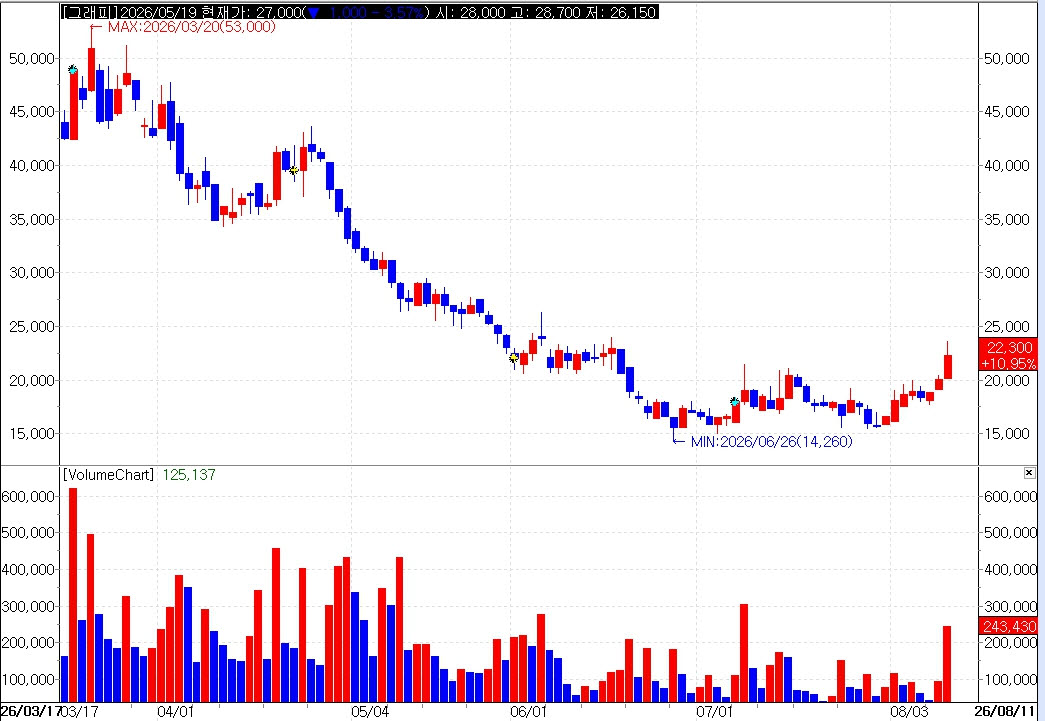 | | Graphy’s stock price trend over the past six months. Shares closed at 22,300 won on Aug. 11, up 10.9% from the previous session, following the announcement of its acquisition of a controlling stake in Ray. (Source: KG Zeroin MP DOCTOR) |
|
Investor interest had already picked up after the company disclosed a deal to acquire management control of RAY following the close of the regular session a day earlier. Graphy shares also gained 2.49% in the Nextrade, or NXT, after-market session.
Graphy plans to acquire 4,087,749 RAY shares, representing a 26.14% stake, from Ray Holdings and RAY CEO Lee Sang-cheol for about 49.2 billion won. If the transaction closes as scheduled, Graphy will become RAY‘s largest shareholder on Sept. 16.
The transaction goes beyond a simple equity investment. Graphy plans to acquire management control by appointing directors and an auditor of its choice at an extraordinary shareholders meeting.
Expectations for synergies between the two companies drove the stock higher.
Graphy owns shape-memory material, or SMA, technology for clear aligners as well as 3D printing materials and manufacturing technology. RAY specializes in three-dimensional dental CT systems, intraoral scanners and software for diagnosis and treatment planning.
Integrating their technologies could allow the companies to build a digital dentistry platform spanning the entire treatment process, from imaging and scanning a patient’s mouth to treatment planning, manufacturing clear aligners and applying them in clinical care.
RAY‘s global distribution network is another potential source of synergy. The company operates in about 70 countries and maintains 14 overseas bases, including operations in the United States, Canada, Germany, France, Japan and China.
Graphy could use RAY’s existing equipment customer base to cross-sell SMA materials and finished products, reducing the time and customer acquisition costs required to enter new markets. RAY, meanwhile, could add recurring sales of materials and aligners used in individual patient treatments to its equipment business, where purchasing cycles tend to be longer.
The scale of the actual synergies, however, will depend on how quickly the companies integrate their products and software after the acquisition and ramp up sales of SMA products through RAY‘s distribution network.
Graphy paid a 2.1 billion won deposit a day earlier and is scheduled to pay 26.78 billion won on Sept. 15 and another 20.28 billion won on Sept. 16.
VATECH rebounds as 3D sales recover, operating profit rises 45% VATECH shares extended gains after the company released preliminary second-quarter results at 2:13 p.m. The stock closed at 22,150 won, up 12.95% from the previous session.
VATECH reported consolidated second-quarter revenue of 121.36 billion won, up 9.7% from a year earlier. Operating profit rose 45% to 24.47 billion won, while net profit surged 200.6% to 22.19 billion won.
Its operating margin reached 20.2%, up 4.9 percentage points from a year earlier, although one-time gains contributed partly to the increase in operating profit.
Of particular note was a rebound in the company’s core 3D product business, which had slowed in the first quarter.
On a standalone basis, sales of VATECH‘s three-dimensional dental cone-beam computed tomography, or CBCT, products fell 20.2% year over year in the first quarter. In the second quarter, however, sales rebounded 6.8% to 42.13 billion won.
Sales of 2D X-ray products rose 14.3%, while revenue from intraoral sensors and other products increased 6.7%, marking growth across all product categories.
Growth accelerated particularly sharply in Europe. VATECH’s European sales growth increased to 23.4% in the second quarter from 11.7% in the first.
Second-quarter sales in France, Germany and the Czech Republic increased 44.2%, 27.1% and 38.9%, respectively. Sales in Asia rose 21.1%, while revenue in the United States and South America increased 2.7% and 7.4%, respectively.
At an investor relations presentation in May, VATECH said demand in the dental imaging diagnostics market was shifting from 2D to 3D products.
In response, the company is pursuing a two-track strategy. It plans to expand premium 3D products with large fields of view, or FOVs, in developed markets while increasing sales of midrange and entry-level products in emerging markets.
VATECH has identified Green X 12 as a next-generation growth product. The system combines CT, panoramic imaging, cephalometric imaging and model-scanning functions.
The company also has an extensive global sales infrastructure. VATECH supplies products to about 100 countries through 25 overseas subsidiaries, with exports accounting for 92.6% of its revenue last year.
Because its overseas subsidiaries handle local marketing and after-sales service, VATECH can use its existing distribution network to quickly expand sales following new product launches.
In the second half, the company plans to strengthen its software capabilities alongside its regional product strategy, focusing on Clever One, a digital diagnostic platform equipped with artificial intelligence functions.
“We continued to grow in key markets, including Europe and Asia, based on our product competitiveness and local business capabilities,” VATECH CEO Hwang Kyu-ho said. “We will continue expanding our global presence by introducing differentiated solutions focused on improving patient convenience and the accuracy of dental diagnostics.”
NGeneBio jumps 14%, but market-cap risk remains NGeneBio closed at 2,275 won, up 13.9% from the previous session, after announcing that its hereditary cancer diagnostic panel had obtained certification under Europe‘s In Vitro Diagnostic Medical Devices Regulation, or CE-IVDR.
NGeneBio said Aug. 11 that BRCAaccuTest PLUS, its hereditary cancer diagnostic panel, had obtained quality management system certification under CE-IVDR. According to the company, it is the first such certification among South Korean breast and ovarian cancer diagnostic panels.
NGeneBio has supplied its BRCA diagnostic panel to markets including Poland, Turkey and Lithuania based on its previous CE-IVDD certification.
Using the new certification, the company plans to expand beyond its existing hematologic cancer products into hereditary and solid cancer diagnostics in Western European markets such as Germany.
It also plans to accelerate regulatory approvals and establish new sales channels in South and Southeast Asia, where CE-IVDR certification carries regulatory and commercial credibility.
BRCAaccuTest PLUS is a next-generation sequencing, or NGS, precision diagnostic panel that simultaneously analyzes mutations in the BRCA1 and BRCA2 genes.
The test is designed to assess disease risk in patients suspected of having hereditary breast and ovarian cancer syndrome and to support clinical decision-making. Compared with the previous product, the panel covers a broader range of genetic variants and uses NGeneBio’s proprietary purification algorithm to cut data processing time by 3.6 times.
NGeneBio, however, continues to face market capitalization risks related to its financial condition and continued listing status.
In April, the company approved a 3-for-1 capital reduction without compensation to offset accumulated deficits and improve its financial structure.
While maintaining the par value at 1,000 won per share, the company consolidated every three common shares into one, reducing the number of outstanding shares to 8,936,583 from 26,809,750. As a result, its paid-in capital fell 66.67% to about 8.9 billion won from 26.8 billion won.
The capital reduction took effect June 25, and the adjusted shares were relisted July 13.
NGeneBio shares had closed at 737 won on June 22, immediately before trading was suspended. On the first trading day following the capital reduction, the stock rose to 1,525 won, moving above the sub-1,000 won penny-stock threshold.
Its market capitalization, however, stood at about 20.3 billion won as of Aug. 11, only slightly above the 20 billion won threshold for designation as an administrative issue on the KOSDAQ market.
Since July, a KOSDAQ-listed company can be designated as an administrative issue if the market capitalization of its common shares remains below 20 billion won for 30 consecutive trading days.
The threshold is scheduled to rise again in January, from 20 billion won to 30 billion won. A company whose market capitalization remains below 30 billion won for 30 consecutive trading days would be subject to administrative issue designation.
That makes NGeneBio‘s ability to translate its CE-IVDR certification into new supply agreements, higher overseas sales and ultimately a higher corporate valuation and share price a key factor in maintaining its listing.
“The certification will mark a turning point as we begin a full-scale expansion of our hereditary and solid cancer portfolio in advanced Western European markets such as Germany, where our business had previously centered on hematologic cancers,” said Song Myung-jun, head of NGeneBio’s diagnostics business.

![Investor Sentiment Rebounds, HLB·VUNO·BNC Korea Drive Market Turning Point[K-Bio Pulse]](https://image.edaily.co.kr/images/vision/files/NP/S/2026/09/PS26092900352b.jpg)

![바람 잘 날 없는 K바이오…오름 ‘임상 중단 쇼크’에 下[바이오 맥짚기]](https://image.edaily.co.kr/images/vision/files/NP/S/2026/09/PS26092100095b.jpg)
![[바이오스터디] AI로 꿀잠 자는 방법 알려드립니다...침실에서 병원까지 데이터로 잠을 분석하는 에이슬립 (이동헌 대표)](https://i.ytimg.com/vi/MM7dtvyr9Go/mqdefault.jpg)