팜이데일리 프리미엄 기사를 무단 전재·유포하는 행위는 불법이며 형사 처벌 대상입니다.
이에 대해 팜이데일리는 무관용 원칙을 적용해 강력히 대응합니다.
[Min Ji-Son, Edaily Reporter] On Aug. 10, South Korean pharmaceutical and biotech stocks broadly advanced as the KOSDAQ rebounded. FromBio soared to the daily upper limit as trading resumed following a 5-for-1 reverse stock split, while Curacle jumped more than 18% on expectations that additional licensing deals could follow its $1.08 billion agreement for retinal disease candidate MT-103.
FromBio hits limit-up on first day back after reverse stock split 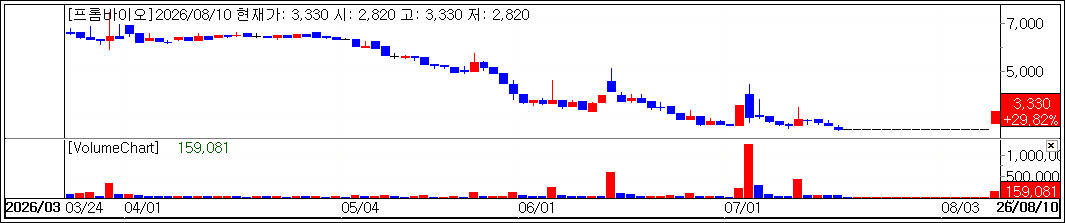 | | FromBio stock trend on August 10.(Image=MP Doctor) |
|
According to KG Zeroin‘s MP Doctor platform, FromBio closed at 3,330 won on the KOSDAQ, up 29.82%, or 765 won, from the previous session.
The rally came as trading resumed following the company’s reverse stock split. While a reverse stock split does not directly change a company‘s underlying value, investors often expect the reduced number of shares outstanding to improve supply-demand dynamics and help shed the perception of a low-priced stock.
FromBio decided in May to consolidate every five shares with a par value of 100 won into one share with a par value of 500 won. The move reduced its total shares outstanding to 5.66 million from 28.31 million. Trading, which had been suspended since July 20 to complete the process, resumed Monday.
The company is positioning the resumption of trading as the starting point for what it calls a “second phase of growth,” with plans to restructure its finances, secure new growth engines and focus more heavily on profitability.
Chief Executive Shim Tae-jin has also sought to support the stock. After the company’s losses widened in the first quarter, Shim purchased a total of 280,000 FromBio shares through two open-market transactions in June.
The key question now is whether the company can improve its earnings and financial position.
FromBio generated 72.2 billion won in consolidated revenue last year, up 7.4% from the previous year. Its operating loss narrowed to 18.6 billion won from 24.3 billion won, but the company remained in the red.
First-quarter revenue rose 3.6% year over year to 19.2 billion won, while its operating loss widened to about 3.3 billion won from 2.3 billion won. Advertising expenses increased to 5.2 billion won from 4.2 billion won, while sales commissions climbed to 6 billion won from 4.5 billion won. Combined, the two expenses totaled roughly 11.2 billion won, equivalent to about 59% of quarterly revenue.
Financial pressure also remains. As of the end of March, FromBio had 14.3 billion won in current assets against 35.7 billion won in current liabilities. Short-term borrowings stood at 32.55 billion won, compared with just 1.49 billion won in cash and cash equivalents.
Investors will therefore be watching whether the company‘s financial restructuring efforts translate into lower debt and stronger cash flow.
Meanwhile, FromBio is seeking to improve profitability in its core health functional food business while developing cosmetics and biotechnology as new growth engines. Its subsidiary FromBio Cosmetics is expanding offline distribution beyond its online-focused sales model.
In biotech, the company is developing a hair-loss treatment based on differentiated cells derived from human adipose-derived mesenchymal stem cells, or dADSCs. Preclinical efficacy studies showed increased hair growth and hair follicle formation in animal models, while general toxicity studies have been completed.
Biodistribution and tumorigenicity studies are now underway, alongside the establishment of a cell bank to ensure consistent quality of clinical trial material. FromBio aims to file an Investigational New Drug application next year.
Curacle jumps 18% on expectations for another licensing deal 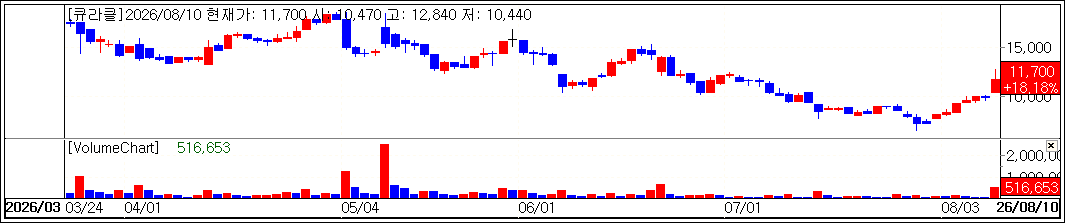 | | Curacle stock trend on August 10.(Image=MP Doctor) |
|
Curacle closed at 11,700 won, up 18.18%, or 1,800 won, from the previous session.
The rally followed a brokerage report highlighting the possibility that additional licensing deals could emerge from Curacle’s pipeline after the company‘s major global deal for retinal disease candidate MT-103.
Shinhan Securities published a report Monday titled “Memento’s Memo: Finding the Next Licensing-Out Deal,” identifying MT-101 and CU01 as potential candidates for follow-on transactions.
“Additional licensing deals for follow-on assets are likely to accelerate if MT-103 enters a global Phase 1 trial and generates positive data,” Shinhan Securities analyst Lee Ho-chul said.
Curacle develops therapies for diseases associated with vascular endothelial dysfunction. Its pipeline combines antibody drugs co-developed with Maptics and internally developed oral small molecules.
In 2024, Curacle signed a joint research and development agreement with Maptics, adding eight programs targeting difficult-to-treat vascular diseases affecting the eye, kidney and other organs. The two companies share proceeds from the programs equally.
MT-103, the lead program, is a bispecific antibody designed to block vascular endothelial growth factor, or VEGF, while activating Tie2, a receptor involved in blood vessel stabilization. It is being developed for retinal diseases including wet age-related macular degeneration and diabetic macular edema.
In May, Curacle licensed global rights to MT-103 to U.S. drug developer Memento Medicines in a deal worth up to $1.08 billion, including an $8 million upfront payment.
Memento has raised 139.5 billion won in Series A financing to independently develop MT-103 and is targeting the start of a global Phase 1 trial next year.
MT-101 is considered one of the most likely candidates for Curacle‘s next licensing deal.
The antibody activates Tie2 to stabilize renal blood vessels and is being developed for acute kidney injury and chronic kidney disease. Acute kidney injury remains an area of significant unmet medical need, with no approved disease-modifying treatment.
In preclinical studies, Curacle said MT-101 protected kidney function, promoted recovery of damaged tissue and inhibited both progression to chronic kidney disease and renal fibrosis. The company is reportedly in licensing discussions with multiple global pharmaceutical companies.
Market observers believe the MT-103 deal could strengthen Curacle’s position in those negotiations by demonstrating the global commercial potential of its antibody pipeline.
Still, the Tie2 approach carries development risk and has yet to establish broad clinical validation. Roche removed its Tie2 agonist antibody RG6351 from its pipeline after advancing it into global Phase 2 development this year, while Astellas is also reported to have dropped its Tie2 agonist antibody ASP4021.
CU01, a small-molecule candidate, is another potential licensing asset.
The program repurposes dimethyl fumarate, an approved multiple sclerosis treatment, for diabetic kidney disease. Curacle completed a domestic Phase 2b trial last year.
Lee said both CU01 dose groups achieved statistically significant reductions versus placebo in the primary endpoint, urinary albumin-to-creatinine ratio, or uACR, a measure of protein leakage into urine.
However, the study failed to achieve statistical significance for estimated glomerular filtration rate, or eGFR, a secondary measure of kidney function, which Lee attributed to the limitations of the 24-week follow-up period.
Lee pointed to AstraZeneca‘s Farxiga as a precedent. The drug failed to show statistical significance in the secondary mGFR endpoint in short-term Phase 2 data at six weeks, but later generated positive long-term Phase 3 results and secured FDA approval.
“CU01 will likewise need to demonstrate efficacy in longer-term Phase 3 data,” Lee said.
![바람 잘 날 없는 K바이오…오름 ‘임상 중단 쇼크’에 下[바이오 맥짚기]](https://image.edaily.co.kr/images/vision/files/NP/S/2026/09/PS26092100095b.jpg)


![[바이오스터디] AI로 꿀잠 자는 방법 알려드립니다...침실에서 병원까지 데이터로 잠을 분석하는 에이슬립 (이동헌 대표)](https://i.ytimg.com/vi/MM7dtvyr9Go/mqdefault.jpg)