팜이데일리 프리미엄 기사를 무단 전재·유포하는 행위는 불법이며 형사 처벌 대상입니다.
이에 대해 팜이데일리는 무관용 원칙을 적용해 강력히 대응합니다.
[Min Ji-Son, Edaily Reporter] On Aug. 20, South Korean pharmaceutical and biotech stocks tied to messenger RNA, or mRNA, cancer vaccines drew heavy investor attention after Moderna and Merck & Co. reported positive Phase 3 results for their personalized cancer vaccine program.
Buying spread across companies with mRNA platforms, delivery technologies and oncology assets as investors searched for potential beneficiaries of the clinical readout. Samyang Biopharm hit the daily upper limit, while several other mRNA- and immuno-oncology-related stocks posted double-digit gains.
Samyang Biopharm hits limit-up on dual mRNA catalysts 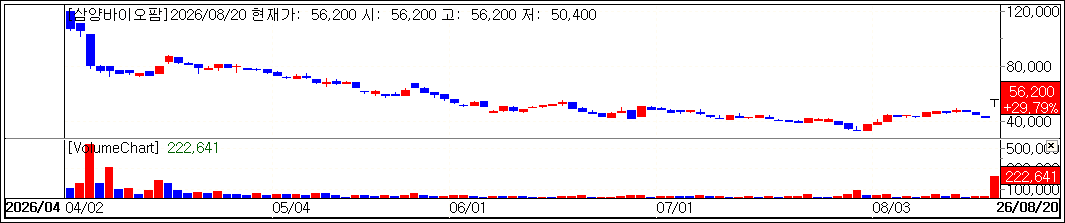 | | Samyang Biopharm stock trend on August 10.(Image=MP Doctor) |
|
According to KG Zeroin‘s MP Doctor platform, Samyang Biopharm closed at 56,200 won on the KOSPI, up 29.79%, or 12,900 won, from the previous session.
The stock surged as Moderna and MSD’s Phase 3 success highlighted the potential of mRNA technology in oncology. Investor sentiment received an additional boost after Samyang Biopharm disclosed preclinical data for its own mRNA cancer vaccine delivery platform on the same day. The company said the timing of the two announcements was coincidental.
Samyang Biopharm said a paper detailing preclinical results for NanoReady, a delivery system based on its proprietary SENS gene delivery platform, was published in the Journal of Controlled Release.
In non-human primates, NanoReady loaded with cancer antigen mRNA selectively delivered the payload to spleen cells involved in immune function and induced T-cell immune responses against the tumor antigen, according to the company. No signs of systemic toxicity were observed following repeated dosing based on blood and tissue assessments.
NanoReady is designed so that the delivery vehicle can be manufactured and stored in advance, with the desired mRNA added later. Once patient-specific mRNA is prepared, it can be mixed with the delivery system to produce a vaccine, potentially shortening manufacturing timelines for personalized cancer vaccines.
“Conventional lipid nanoparticles need to be manufactured together with mRNA after the mRNA itself is ready,” a Samyang Biopharm official said. “With NanoReady, the delivery vehicle can be prepared in advance without mRNA, allowing a personalized vaccine to be made more quickly once the patient-specific mRNA becomes available.”
Unlike conventional lipid nanoparticles, or LNPs, NanoReady has a multilayer structure. Samyang Biopharm said it can carry roughly 20 times more mRNA per particle than LNPs.
The company also said the platform does not use PEG lipids or phosphatidylcholine-based helper lipids, which could help reduce the risk of hypersensitivity reactions or accelerated clearance associated with repeated administration.
Samyang Biopharm plans to apply NanoReady to its own pipeline while also remaining open to global licensing and co-development opportunities.
“NanoReady could be licensed out, but we could also discuss collaborations involving joint development of drug candidates,” the company official said. “Once our dedicated gene therapy manufacturing facility in Daejeon is completed, which is targeted for the third quarter of next year, we expect follow-on development of NanoReady-based candidates to accelerate in the second half of next year.”
Moderna readout lifts broader mRNA and oncology names The rally extended well beyond Samyang Biopharm, with investors bidding up Korean companies linked to Moderna, MSD or mRNA and cancer vaccine technologies.
SomaGen, which has provided DNA and RNA genomic analysis services to Moderna, rose 29.98% to 3,750 won.
Naibec, which is developing PEPTARDEL, a peptide-based mRNA drug delivery platform designed as an alternative to conventional LNPs, climbed 19.82% to 19,100 won.
Alteogen, which licensed subcutaneous formulation technology to MSD for Keytruda, rose 11.86% to 339,500 won. ST Pharm, which owns mRNA capping and LNP delivery technologies, gained 11.68% to 110,900 won.
Buying also spread to companies with looser links to mRNA delivery but exposure to cancer vaccine or immunotherapy combination strategies.
GI Innovation gained 7.98% to close at 8,800 won. The company told shareholders that the Moderna-MSD readout could have positive implications for the development and commercialization of GI-102, its immuno-oncology candidate.
GI Innovation said the results support the broader potential of combining cancer vaccines with immune-activating agents.
“Moderna‘s personalized cancer vaccine is designed to induce immune responses against tumor-specific antigens, and the company aims to expand beyond melanoma into other cancers,” GI Innovation said. “To amplify the immune response generated by the vaccine, IL-2 can play an important role, which could increase the value of safer IL-2 candidates such as GI-102.”
MedPacto also advanced 6.37% to 2,590 won as investors focused on the potential use of its TGF-beta inhibitor vactosertib as a combination therapy that could enhance cancer vaccine-induced immune responses.
The company recently published preclinical data in Nature Communications on a combination of vactosertib and PROTEXI, a cancer vaccine platform developed by U.S. affiliate Celloram.
In animal studies, tumors in the combination group shrank to less than 25% of the size seen with PROTEXI alone. At day 25, survival exceeded 75% in the combination group, compared with roughly 50% in the vaccine-only group.
“Cancer vaccines have faced limitations including insufficient immune responses, modest efficacy and difficulty designing clinical strategies,” a MedPacto official said. “Vactosertib improves the immunosuppressive tumor microenvironment and helps immune cells attack cancer more effectively, making it potentially meaningful as a combination strategy to enhance cancer vaccine efficacy.”
Another link comes from MedPacto’s largest shareholder, Theragen Etex, whose subsidiary Theragen Bio is participating in the South Korean government‘s ARPA-H-style PAVE project to build a personalized cancer vaccine development platform.
According to MedPacto, the related cancer vaccine program has completed preclinical work and is preparing to enter clinical development.
“Moderna’s latest results could broaden confidence around the clinical development and regulatory pathway for personalized cancer vaccines,” the MedPacto official said. “That could create a more favorable development environment for companies that already have core technologies and are preparing to enter the clinic.”
Still, some market participants cautioned that the rally may have gone beyond companies with direct exposure to the Moderna-MSD program.
Moderna shares surged 177% in U.S. trading overnight, while MSD also reached a record high, fueling a rapid spillover of investor enthusiasm into Korean stocks perceived to have links to mRNA cancer vaccines.
“Moderna‘s Phase 3 success is clearly positive in that it strengthens confidence in mRNA cancer vaccines and combination treatment strategies,” one biotech industry official said. “But the fact that investor sentiment improved even for companies with no direct connection to Moderna or MSD suggests some of the rally may be short-lived. Investors will need to watch whether the excitement translates into actual licensing deals, orders or other commercial results.”
![Samyang Biopharm Hits Limit-Up as Moderna-MSD Cancer Vaccine Data Spark mRNA Rally [K-Bio Pulse]](https://image.edaily.co.kr/images/photo/files/NP/S/2026/08/PS26082001405.jpg)

![[바이오맥짚기] '로열티·기술이전·독점권' 모멘텀 장착…헬릭스미스·지놈앤컴퍼니 급등](https://image.edaily.co.kr/images/vision/files/NP/S/2026/10/PS26100100218b.jpg)


![“AI가 후보물질 만들면 프로티나가 검증”…신약개발 병목 ‘웨트랩’ 정조준[인베스트 바이오]](https://image.edaily.co.kr/images/vision/files/NP/S/2026/10/PS26100300159b.jpg)