[Kim Jinsoo, Edaily Reporter] Park Tan, a CrossFit athlete and gym owner, underwent surgery on both knees using Biosolution‘s “CartiLife” in June 2024. More than a year and a half later, medical scans indicate his cartilage is still regenerating.
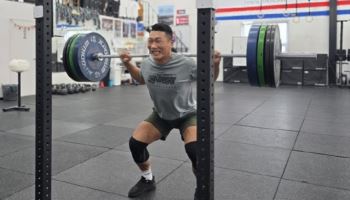
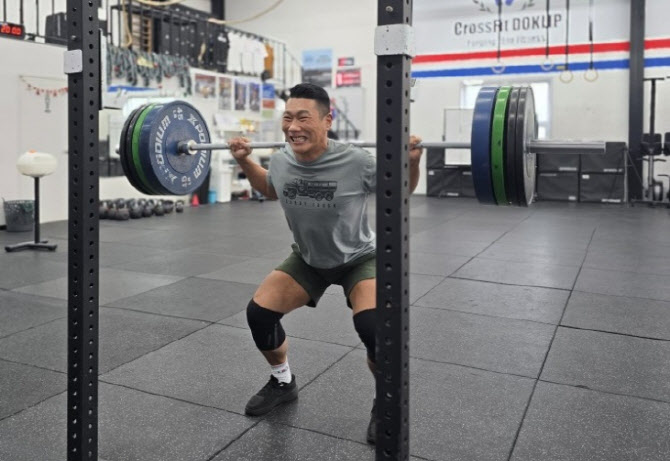 | | Park Tan, a CrossFit athlete and representative of the CrossFit Independent Training Center, performs rehabilitation exercises following knee surgery. |
|
“Hospital tests confirm that the knee cartilage is continuing to regenerate even now, more than a year and a half after the procedure.” Park said in an interview Tuesday at a training center in Cheonan South Chungcheong Province.
“I have undergone two checkups post-surgery and will soon have my third,” he added. “Given that I’ve been told the condition of my knee cartilage has sufficiently improved this will likely be my final examination.”
Park was diagnosed with Grade 4 cartilage defects in his right knee in January 2024. Following a debridement procedure to remove damaged cartilage caused by severe inflammation he placed excessive strain on his left knee resulting in a Grade 4 defect in that joint as well.
“As the cartilage damage worsened even ordinary daily activities became difficult.” Park said. “I couldn‘t squat down to put shoes on my child. On a short flight to Japan the inflammation caused such severe swelling that I couldn’t stand up when the plane landed.”
seeking a fundamental solution, Park explored various surgical options before selecting CartiLife a procedure that does not require altering the bone structure.
“I felt that microfracture surgery, which involves drilling holes into the bone, carried significant risks if something went wrong,” Park explained. “Since my livelihood depends on athletics, rapid recovery was crucial. I judged that CartiLife would be advantageous for rehabilitation because it preserves the bone.”
CartiLife, developed by Biosolution, is an autologous cell therapy product. It involves culturing cells harvested from the patient‘s own rib cartilage. Because the procedure implants pre-made cartilage tissue, it does not require microfracture surgery. A key advantage is the use of the patient’s own cells, which minimizes immune rejection and facilitates natural cartilage regeneration.
Park underwent a minor procedure to harvest rib cartilage in April 2024, followed by the CartiLife implantation in June. He reported a rapid recovery, walking without a walker just five weeks after the surgery.
“Although the rib cartilage harvest required a separate, minor surgery, it wasn‘t particularly inconvenient.” Park said. “Considering I was walking a little over a month after the knee surgery the total recovery time including the six week interval between harvest and implantation was much faster than recovering from a procedure that damages the bone.”
The recovery was bolstered by the regeneration of the cartilage itself. CartiLife implants bead shaped cartilage pellets into the defect. These pellets initially fill the defect and the extracellular matrix secreted by the transplanted cells subsequently promotes further regeneration.
Notably, the regenerated tissue is hyaline cartilage, which is identical to the original knee cartilage. Therapies involving microfracture typically result in fibrocartilage, which is generally considered lower quality than the hyaline cartilage produced by this treatment.
“In an early checkup, I was told there was a slight defect in an area outside the surgical site.” Park said. “However a follow up exam months later showed that the defect had been filled to some extent. The cartilage had been continuously generating during that time.”
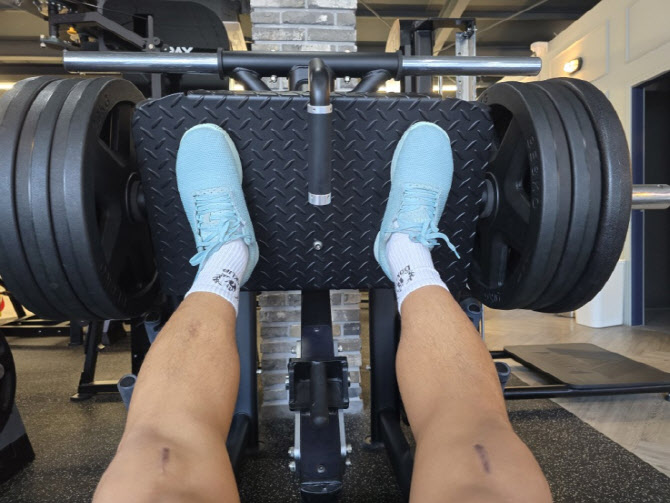 | | Park Tan, a CrossFit athlete and representative of the CrossFit Independent Training Center, performs rehabilitation exercises following knee surgery. |
|
A Biosolution representative explained the mechanism.
“While CartiLife involves the direct transplantation of cartilage, natural hyaline cartilage continues to generate for approximately two years thereafter.” the official said. “With other treatments, the amount of cartilage often decreases as it detaches after surgery, but with CartiLife the volume actually increases.”
Park said his functional recovery is complete.
“Structural recovery has been achieved and the hospital has stated that further MRI scans are unnecessary.” Park said. “I can currently squat up to 150 kilograms (330 pounds). I plan to focus on functional recovery to resume high-intensity training, including CrossFit.”

![김경민 용인세브란스 교수 "GLP-1 비만약, 복합제보다 투약 주기 관건"[전문가 인사이트]](https://image.edaily.co.kr/images/vision/files/NP/S/2026/02/PS26020301154b.jpg)
![아프리카돼지열병 유행에 코미팜↑…'로슈 파트너' 바이오다인도 주목[바이오맥짚기]](https://image.edaily.co.kr/images/vision/files/NP/S/2026/02/PS26020500293b.jpg)